Showing posts with label women. Show all posts

Wednesday, January 25, 2017

This is What Democracy Looks Like

There is a simple and catchy chant haunting my waking thoughts. I heard it echo down Market Street and into Luther Ely Smith Square on the voices of thousands the day after Inauguration Day. One female voice would begin to shout, then women and men alike picked up the call and response chant over and over: “This is what democracy looks like!”

The Women’s March in Washington D.C., here in St. Louis, and in every major American city had the remarkable effect of propelling millions of women out from behind computer screens in their homes and into the streets to look each other in the eyes with common cause. Marchers, media, and members of Congress are now all asking the same questions: “What comes next? What will democracy look like for this group moving forward?”

As Former-President Obama urged in his Farewell Address, “If something needs fixing, lace up your shoes and do some organizing.” In order for a new women’s movement to gain traction and start changing the world, the next step participants will have to take is to march back to their computers armed with newfound inspiration and local networks. Now is the time to do the next scary thing and learn new skills that lie firmly outside of most personal comfort zones. Now is the time to learn how to effectively advocate for all the things worth shouting about.

Late night organizing in a Washington D.C.
hotel. Super glamorous, yeah?
Truly effective advocacy work is hard and unglamorous. It requires making commitments and carving out time from already busy schedules. It means joining groups with people who probably don’t feel exactly the way you do about all things in life. Listening to them, learning from them, and making compromises is necessary to form strong and lasting teams. Organizing with respect and persistence is difficult, but ultimately so much more effective and satisfying than shouting into a cyber abyss alone. New organizers and advocates will need to remember the exhilaration from the march to sustain energy in the rigorous work of organizing and taking actions.

My own dream is for us – no matter where we stand politically – to capture the energy of this moment and transform it into actions that defend human rights and empower women to break the cycle of poverty for themselves and for their children. If we can launch an unprecedented movement of citizen advocacy and hard work to change policies, then it will be a true success for years to come.


My advice to activists is this: Keep in touch with your social media connections and commit to working together in real life. Find people working on the same issues that you are passionate about. Meet face-to-face with each other and connect with a reputable advocacy group to teach you the skills you need. Support each other to overcome inhibitions and get up to speed quickly, so you can train others on how to call Congress and write letters. Learn how to write letters to the editor. And then, finally, take that leap to sit down face to face with your members of Congress and their aides. Unlock your power as a citizen and inspire Congress to work together to change the world. Because this is what democracy looks like.

A meeting of constituents with U.S. Representative Jan Schakowksy

Thursday, September 1, 2016

The Strong Women of Jeju Island

This traditional Korean statue of a Jeju Island woman collecting water
also has working water spigots in this sculpture garden.
This summer, I travelled to South Korea with my daughter. Our guide (and Taekwondo instructor!) had the clever foresight to make Jeju Island our first stop. Located 130 km from South Korea's southern coast, the island is the country's largest island, smallest province and one of the New Seven Wonders of the World. It's perfect for relaxing when you need to readjust your internal clock. We were a few of the 9,000,000 tourists per year who visit this beautiful volcanic island. Geology aside, I found another aspect of the island's reputation to be particularly fascinating. You see, Jeju Island is known for the strength of it's women...leading to the nickname: "The Women's Island."

Wow! Who knew a place like that would exist in a country that struggles in regard to the status of women (particularly in business and politics)? Yet here is a pocket within Korean culture where the strength of women has openly celebrated for generations. On Jeju, women have long been a majority population and held economic power. An article from JejuWeekly.com explains:
"Historically, Jeju has been known as an “island of women” as females outnumbered males, worked alongside men in both agrarian and marine labor, and typically had economic control in their families. Under the rule of the Joseon Dynasty, which exalted Confucianism and firmly elevated men over women, the birth of a daughter was nevertheless a happy occasion in Jeju's coastal villages as she could become a “haenyeo” (diving woman) and thus earn money for her family."
A picture of mannequins in a museum since I was too far away
to get a good shot of the real women doing the real job.
Diving women? Yeah! For centuries, women on Jeju Island called "Haenyeo" have supported their families by harvesting conch, abalone, octopus, and other creatures by hand from the ocean floor. They are a symbol of female independence and strength.

Even today, you can see them diving using no breathing equipment even though they are down for around two minutes as deep as 10 meters underwater.  They dive with masks and lead weights (to make them sink faster) and a round flotation device to hold a net for the harvest. 

It's dangerous work. Between 2009-2014, 40 diving women died. According to the New York Times, the number of these "sea amazons" has dwindled to about 4500 from 26,000 in the 1960's with 84% of them 60 year old or older. Nowadays, younger women on Jeju Island prefer to work in hotels or rental car agencies for the tourism industry, but that wasn't available to their grandmothers. Diving offered the women respect and economic freedom to decide where family income was spent. Talk about a working mom!
A mannequin in a museum models the traditional dress of a
woman carrying water.
At first glance, the independence of the Jeju women sounded great to me, but further research revealed that things weren't quite so rosy. There is a local saying - "Better to be born a cow than a woman" - that speaks to the rough and physically grueling life they lived. Even if a woman was out of the water, she still couldn't escape the same job held by millions upon millions of girls and women since the beginning of time...hauling drinking water.


The real deal. These ladies in the photo aren't models!

Before running water was available, islanders obtained drinking water from rain or coastal springs. Women carried water on their backs using earthenware jars strapped in bamboo baskets. Until the 1960's, water in mid-mountain villages (where the water supply was scarce) was collected by girdling a large tree with a belt fashioned of grass, which led the water flowing down the trunk into a jar. 

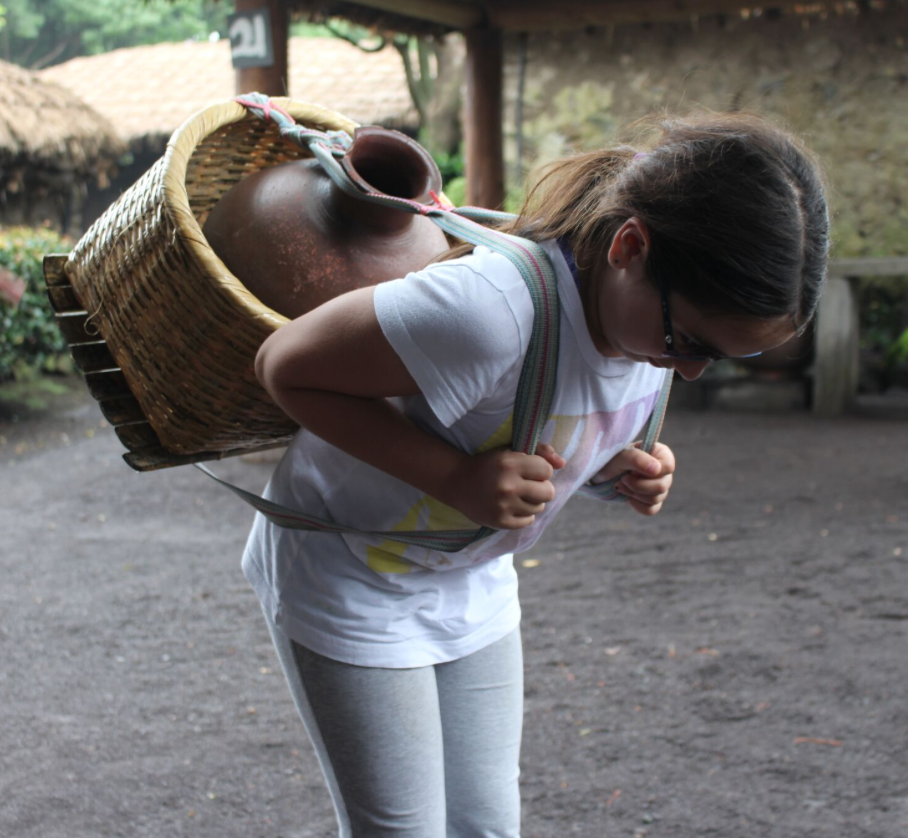
This image is so important to the culture that stone statues around the island recall the strength of the women who carried the life-sustaining water on their backs for years. My daughter got to try carrying one of the traditional jars herself. She says the jug itself was pretty heavy even when it was completely empty...and she is a strong Taekwondo black belt herself!

My daughter tries out a water jug her size. 


I'm glad I got a chance to learn about the Jeju women alongside my girl. It helped give us a historical perspective of women in a small community within a country we hadn't visited before. 

Gender equality is #5 on the list of the Global Goals for Sustainable Development. We simply cannot end poverty without it. Because the basis of so many economies lies on the backs of so impoverished women, we owe it to ourselves to learn about gender roles around the world and support organizations and policies that help women lift themselves and their families up on a path to independence and respect. 


Here are just a few ways to be part of the solution:
  1. Join or donate to BRAC: BRAC takes a holistic approach to ending poverty in several ways including: microfinance, education, healthcare, gender justice and empowerment. They give women the tools they need to take control of their own lives. 
  2. Join or donate to Girl Rising: Girl Rising uses storytelling to inspire action that gets girls into classrooms worldwide. Watch a film on their website and tell your community about why girls' education matters. Sign up to be informed about advocacy actions you can take to help.
  3. Donate to Water.org: Water.org helps bring clean drinking water to communities so that valuable time and energy is not lost when women and girls haul water for their families' daily use. Donating to them provides water infrastructure and supports the advocacy they do as an organization (although I don't think they have an action alert system for citizens to advocate)


Monday, February 8, 2016

Julia Jenkins Empowers Women with Noonday Collection

I'm so glad I met Julia Jenkins. She is so many things, including...a mom-of-three, a fun/classy lady, and a Noonday Collection Ambassador. If you haven't heard of Noonday, think of it as a fair-trade fashion company that will throw trunk shows at your house with some of the proceeds helping adoptive families. "Wow!" right?

Julia is as passionate as I am about empowering girls and women. I love the fact that she does it in a different way than I do, but it all comes from the same place of love, hope, and practical optimism. She's my guest blogger today, sharing with you how Noonday is empowering her as well as her customers and the artisans that make all the beautiful accessories in the Noonday Collection. PLUS, if you are a U.S. reader and leave a comment for us on this blog answering the question "How do you empower women?" by 9PM CST February 15th, you'll be in a drawing to win a Noonday Collection scarf!
Thank you, Julia, for sharing your story.

Julia's Story
As a Noonday Collection Ambassador, I regularly stand in front of hostesses and their guests telling stories about artisans who make the gorgeous handmade jewelry and accessories I showcase in their homes. While they sip wine, I tell them about how lives are transformed, because of the power having a job. I show them how amazing they look wearing a statement necklace made by one of our artisans. I empower them to change the world and feel beautiful at the same time.

But, here's my secret: Each time I stand up in front of a group of customers, I am trembling (and sweating). The voices in my head say that I'm not pretty enough, thin enough, well-spoken enough, outgoing enough, or confident enough to do this justice.

I advocate on behalf of women---women who depend on the job they have to live, and that happens because of my voice, and your purchases. It’s something I feel very called to do...in spite of my sweaty armpits!

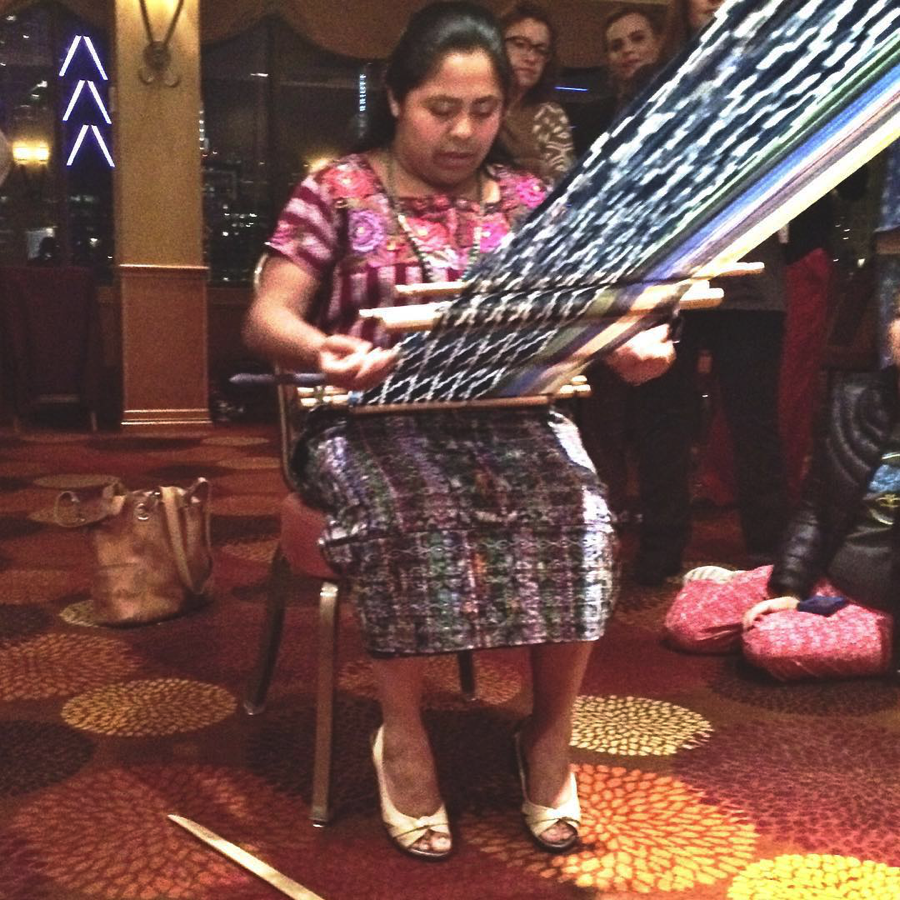
I recently returned from Austin, Texas where I had the privilege of meeting some of Noonday’s partner artisans. It’s incredibly humbling to meet these ladies. This is Ana:

Ana lives in Guatemala and learned the beautiful tradition of blackstrap loom weaving from her mother when she was just seven years old. As she grew, she became unsatisfied with the way she saw economic opportunities for women in her village. She sought out ways to make a difference. At the age of 28, she now owns a business and employs 30 female artisans. Ana partners with Noonday to make beautiful scarves. In this picture, you can see how each one is made. It takes five hours to weave one.

I’ve adopted a really powerful mental exercise that I learned from Melissa Russell, from the International Justice Mission, that she uses before she asks people for money to help her end human trafficking.

I imagine myself sitting down next to Ana, and telling her that I just don't feel confident enough to stand before you, because I’ve gained five pounds, and you have really pretty friends, and over 20 of them will be there, and I get really, really sweaty. It sounds ridiculous, doesn’t it?! 20 ladies who can use their purchasing power for good, so that Ana can hire more single mamas to do weaving. I want to talk to those ladies, and tell them all about Ana!
In spite of myself, and because of the women I represent, I’m an ambassador. And I work at it, so that I can do it better!

Here's what Ana has taught me, and there's something here for you, too. Ana knows she's enough. She was 20-years-old when she started her business. At twenty, she was giving single mamas the opportunity to weave in their homes, so that they can also take care of their small children! And here's the truth: 
You are enough! I am enough, and so is that pretty/thin/well-spoken/confident woman across the room. Her “enough-ness” doesn’t diminish my own. And we can elevate the worth of all women when we stop listening to the voices that tell us where we fall short, and start empowering those around us.
What if we all chose to live wholeheartedly, and pour into women around us, rather than listen to the voices in our heads saying that we don't measure up? When we stomp those voices out, and believe that we are enough, we have the power to change the world!

Ana has this dream of building her business to provide jobs for 100 women! Isn’t that incredible? I want to help her on her way to that goal today. Enter to win the scarf Ana was making by answering this question in the comments by 9PM CST February 15th
How do you empower women? 
We ALL empower the women around us--each one of you can add a voice to this conversation. I can't wait to hear what you have to say!


Thursday, July 22, 2010

Microbicidal gel and education empower women to stay HIV free

There is exciting news in the field of HIV/AIDS prevention!

1) A promising new microbicidal gel has shown that women who used it were 39% less likely over all to contract HIV than those who used a placebo. Regular usage even reduced transmission chances by 54%!

2) A study in Malawi showed that offering impoverished girls small amounts of money for regular school attendance reduced AIDS and herpes infection. After a year and a half of the program, girls who received payments were less than half as likely to be infected than girls whose families got no payments. The girls started to have sex later, less often and with fewer partners.

What this says to me is what we have known all along. Empowering women to make their own choices...whether through education or access to health information and resources...is a key to fighting AIDS and poverty.


Here's the article in the New York Times about it.

Monday, March 8, 2010

Steps to Advance the World's Women (by Nicholas Kristof)

A few insightful suggestions from Nicholas Kristof for International Women's Day! Here are excerpts. The entire article can be read in the New York Times here.

March 8, 2010, 10:30 AM
Three Proven Steps to Advance the World’s Women, on International Women’s Day
By NICHOLAS KRISTOF

"First, I think girls’ education may be the single most cost-effective kind of aid work. It’s cheap, it opens minds, it gives girls new career opportunities and ways to generate cash, it leads them to have fewer children and invest more in those children, and it tends to bring women from the shadows into the formal economy and society...."

"Second, I’d argue for deworming and micronutrients. These may not sound like they’re “women’s issues,” but in a sense they are. For example, iodine deficiency particularly affects female fetuses, for reasons that we don’t fully understand. Insufficient iodine in the first trimester of pregnancy costs that child 10 to 15 I.Q. points for the rest of his or her life, and yet iodized salt programs that prevent the problem cost less than 5 cents per person reached...."

"Third, we need more support for women starting businesses. These can be microsavings and microlending programs, or training in entrepreneurship. BRAC and Grameen have done great work in this area, as has Injaz in the Middle East. Such programs lead women to bring in incomes, and that gives them more weight in the home and society. Moreover, they tend to invest the income in their children, so there’s a broader effect in fighting poverty."