Showing posts with label advocate. Show all posts

Friday, August 26, 2022

Activist Profile: Laura Frisch of Moms Demand Action


Image: Laura Frish (photo by Laura Frisch)

The following is an excerpt from my book, "From Changing Diapers to Changing the World: Why Moms Make Great Advocates and How to Get Started." In addition to stories and quotes from mom-advocates, my book features six mothers in particular whose stories highlight different aspects of advocacy. Laura Frisch, a volunteer for Moms Demand Action for Gun Sense in America, is one of those powerful women. In this section, I invite everyone to consider how to be more inclusive and build stronger communities.

PROFILE: LAURA FRISCH

BUILDING COMMUNITY

Although I have known Laura Frisch for more than fifteen years, I remain amazed at how she uses every opportunity to exponentially group efforts for good and to build up the community around her in positive ways. Frankly, I both admire and fear her abilities because she pushes the boundaries of my own comfort zone. Knowing Laura has made me a bolder organizer.

As a mom of young children, Laura skillfully created a fun and welcoming community for her friends and neighbors; she carried those skills into her local schools and later into troubled Chicago neighborhoods. Now she works to foster a nationwide community that can create a safer place for all. 

When we were both raising little ones in Morton Grove, Illinois, Laura’s house was a swirling epicenter of neighborhood activity. Two kids and four dogs made for a bustling home on the quietest of days, and her door was always open to welcome friends and their kids for anything from an impromptu backyard picnic to a messy tie-dye T-shirt session. 

To Laura, anything worth doing with two friends was worth doing with ten friends! She was so comfortable in the chaos that her first instinct was always to ask, “How can we include more people? How do we make this open and accessible for everyone?” This tendency was both a challenge and an inspiration to an introvert like me, who generally wanted to keep things comfortable and cozy for myself. Yet I knew that whenever I wanted to rally the Morton Grove community, Laura was the secret ingredient for cooking up any of my schemes. 

For example, I once thought it would be good to replace the school’s annual wrapping paper fundraiser with a walkathon so our kids could do something healthy instead of generating more disposable waste. I laid my idea at Laura’s feet. Before I knew it, we had a school day set aside for a walkathon and a volunteer committee of parents scurrying to find sponsors, collect donations, and judge a T-shirt design contest. 

Laura didn’t stop there. She arranged for a school for students with emotional or physical challenges to participate in our walkathon and to share in the proceeds, too. That school had significant financial needs but no parent organization to raise money. Laura took my idea and made it bigger. More inclusive. More accessible. I moved away from Illinois in 2013, but I kept in touch with Laura, and I wasn’t surprised when she became involved with a nationwide advocacy group in the aftermath of the 2012 Sandy Hook Elementary School shooting. Laura, who had been teaching a park district preschool class on the day of the shooting, said, “It was like Pearl Harbor Day. I distinctly remember I was working in one of those little one-room schoolhouses. No protection there. I thought about how I’ve had incidents where divorced parents tried to pick up kids without authority and I had to call the police.” In those times of conflict, it had only been Laura and two helpers caring for fifteen preschoolers. No security backup. 

The thought of what could happen if an armed person came with the intent to harm her or her class prompted her to join the Facebook group of Shannon Watts, an Indiana stay-at-home mom who felt compelled to take action after the Sandy Hook massacre. Shannon started a nationwide discussion among mothers about how Americans could and should do more to reduce gun violence. This impromptu group went viral and eventually became Moms Demand Action for Gun Sense in America. It’s now a widespread grassroots movement of Americans who are fighting for public safety measures to reduce gun violence. Members advocate for stronger gun laws and work to close loopholes that jeopardize public safety. They also work in their own communities and with business leaders to encourage a culture of responsible gun ownership. 

Image: Missouri Moms Demand Action advocates
at 2020 lobby day in Jefferson City, MO
Photo by Becky Morgan

Nowadays, Moms Demand Action is an advocacy juggernaut that inspires seas of supporters in read T-shirts to descend upon state legislatures to promote "gun sense" legislation. The organization has at least one chapter in every state and over eight million supporters. But Laura was there in the early days when Moms Demand Action consisted of small pockets of moms around the country who were simply trying to start conversations about gun safety.

“We were a total ragtag little team of people who started out saying, ‘Let’s talk about it at our PTO meetings’ and turned it into ‘Let’s find out how to lobby,’” she recalled. At the time, she had no idea how big the movement would become or that she would bring the Moms Demand organization to the whole North Shore area of Chicago. 

In addition to Laura, several Moms Demand members lived in Chicago or its suburbs, and one of them learned a mother had been killed while protecting her child from a drive-by shooting. So, a couple of nearby members went to sit in solidarity with neighbors on the Englewood corner where that mother had been shot. Laura believes it’s important to know that Moms Demand volunteers went with a spirit of partnership to places where allies were already working against gun violence, rather than simply showing up after a shooting for a photo op. “It’s more like, when there was a group there already, they’d say, ‘Come and help,’ and we’d show up to support each other.” 

In Englewood, what began as a small vigil on a corner started by Tamar Manasseh of MASK, Mothers and Men Against Senseless Killings, soon blossomed into a regular event the community could count on for safety. The gatherings went like this: Take char- coal and food for seventy-five people to a local park. Bring along a local Lutheran pastor, Islamic leaders, and Jewish congregants. Get together and talk to people in a block-party setting. Feed everyone. The atmosphere was energizing and loving. On these block party nights, kids in the neighborhood knew this would be a safe spot where they could get something to eat, which was important because many of the kids were food insecure. Laura would set up a face-painting table, something she often did for events at her synagogue and the Morton Grove Farmers’ Market. Her face painting gave kids a chance to sit down with a safe adult for one-on-one time, helping them build positive memories of being a kid. 

Moms Demand volunteers in Chicago continue to work with local groups organizing these kinds of gatherings to provide whatever is needed. They strive to make these areas feel safer and to help children escape the fear they carry with them. Members also listen to kids tell stories of the people they have lost. 

Laura’s role with Moms Demand Action grew as the organization addressed more state and national initiatives, including speaking to legislators and supporting a campaign to spread safety awareness among gun owners. But she still makes time to go back to that same Englewood gathering, which never stopped trying to make that corner a safe place to be. Even though MASK runs the event on its own, Laura still goes twice a year, bringing more people with her each time. 

“It’s hot and there’s very little shade,” Laura admitted. “It’s a schlep down there, but we go back every year. Every single time I’m thinking, ‘This is affecting people in a positive way,’ so I keep going.” 

When she reflected upon how the organization has expanded from the eclectic group of volunteers who gathered in the early days, Laura said, “Moms Demand was the sorority everyone could join. Of course, it’s serious business. Many people joined because they lost a child or loved one to gun violence, so it wasn’t all fun with sisters. But everyone was welcome.” 

Baking this kind of inclusiveness into the organization’s culture has helped it grow and gain power. With a problem as widespread as gun violence, it’s important to get all kinds of allies on board to create and run safety campaigns and encourage the election of gun-sense candidates. They may have started as a bunch of moms, but those moms knew they needed to enlist the help of dads, kids, hunters, gun-toting grandmas, members of Congress, and even conservative news pundits. 

Not long after my 2019 conversation with Laura, conservative CNN host S. E. Cupp—nationally known as an outspoken supporter of the National Rifle Association (NRA)—announced on air that she had dropped her NRA membership in the wake of mass shootings in El Paso, Texas, and Dayton, Ohio. In an impassioned speech, she spoke in favor of legislative measures that Moms Demand advocates had promoted for years: universal background checks, bans on the sale of large drums of ammunition, and measures to prevent domestic abusers from having access to guns. Just four years earlier, Cupp had appeared in an advertisement as a self-proclaimed “NRA mom” who urged others to join the NRA. I don’t know whether Cupp will join Moms Demand, but I think she would find that sorority accepting of her. 

Building movements and organizing volunteers is hard. It can be messy when a lot of different personalities and viewpoints clash. But changing the world takes a wide diversity of voices and personalities, and we don’t always get to pick and choose who shows up to help. Laura understands that if we work only with people who look like us, shop like us, worship like us, and play like us, then we are not going to change much of anything at all. Her solution is to welcome everybody. 

When I asked what drives her sense of inclusivity, Laura denied suggestions that it came from her religion or early role models. Instead, she said, “I was lonely as a kid. I’m never going to make someone not be included. I’ve stood in those shoes and I’m not going to make anyone else stand in them.” 

Most of us have felt lonely and left out at times in our lives. Let’s channel those feelings as Laura does to make others feel more comfortable as we work together. Building inclusive movements is the greatest gift we can share to take powerful actions and help more people. 


Image: Book cover

Buy an autographed copy of "From Changing Diapers to Changing the World: Why Moms Make Great Advocates and How to Get Started" at my website www.changyit.com or order it from Amazon, Barnes and Noble, or any independent bookstore!

Monday, May 10, 2021

Going the Extra Mile with Advocacy

Logo for
"The Extra Mile" podcast
I recently started listening to the Extra Mile podcast hosted by Charity Miles founder Gene Gurkoff. He interviews people going the extra mile for health and to make an impact. It made me reminisce about how I started using Charity Miles (a walking/running app that donates money according to your distance to causes you select) to “go the extra mile” for global immunization and hunger causes. I already gave money to organizations working on those issues, and Charity Miles became another way to contribute. But the biggest way I know how to go an extra mile for global health is to advocate.

Most people don’t really know what a volunteer advocate does, how it’s different from service volunteering, or how impactful the work can be. That’s why I started telling people the story of the river metaphor that I first heard at a Bread for the World conference. Here, I’ll tell it to you…

The River Metaphor

Image: A rocky river with a sharp 
dropoff ahead
Imagine you are having a picnic near the banks of a river. You hear a cry for help and see people fighting for their lives in the middle of the current. Mothers try to hold their babies above the water, but they are drowning. Children are being sucked under with exhausted parents.

You and your friends toss ropes into the raging waters to reach as many people as you can, one by one. The survivors are grateful, but they point upriver where even more victims are swept helplessly along. Maybe your buddies devise a brilliant system of ropes and pulleys to rescue multiple people, but there are far too many to save.

While your party is fishing people out of the raging waters, you turn your eyes upriver and wonder: “Why is this happening? Did a bridge collapse? Is there someone pushing people in the river? Is there some terrible danger up there that makes a perilous plunge the better choice?”

You hike upstream to prevent people from falling into the river in the first place. Because you are a change-focused advocate, you hike that extra mile to find the root cause of the suffering and strategically use your influence to eliminate that cause so that no one has to drown. Once you figure out a strategy to save the most people, you will speak up and convince your community to follow your plan.

Direct Service Versus Advocacy

The river illustrates the difference between “direct service” and “advocacy.” Direct service workers give of their energy and talents to help people in crisis. Disaster relief workers, soup kitchen servers, and polio vaccinators are examples of direct service providers. On-the-ground relief work can be incredibly satisfying as it connects volunteers directly to individuals who need help. Most people think about direct service when they think about volunteering and charity work.

Change advocates go the extra mile. They look for preventative solutions. They rally even more help for the long term.

At its best, advocacy is about seeking out root causes, finding effective solutions, and persuading other people to help implement those solutions.

I admit, the work can feel far removed from the people you are trying to help, which some find less rewarding than direct service roles.

Working to change a system requires an ability to delay desires for instant gratification and personal thanks. But when you know that no more people will fall into the metaphorical river or—in the real world—that children in your community are no longer need to go to a food bank for meals, it feels good knowing that you saved many more people than you ever could have if you never took the mental leap to leave the riverbank.

Serving Millions, Not Hundreds

As a busy mom, I have learned to ask myself: “Since I’m just one person, what’s the best use of my volunteer time to help the most people?”

When I was childless and single with lots of free time, I served dinner in a church soup kitchen. Standing behind serving tables, scooping casserole and welcoming hundreds of people became a highlight of my month. It warmed my heart to hear their words of thanks and to see children happily munching.

Over time, I worried about what soup kitchen clients did on days when they couldn’t get hot meals from the church. So, I moved a little farther upstream and began volunteering with the Greater Chicago Food Depository to supply food pantries all around the area. Although I felt like my work was making a difference, my personal efforts seemed dwarfed by the immense need. Unfortunately, even those efforts ended after my first baby was born. I stepped away from hands-on projects they weren't compatible with the hands-on work required for baby care.

Bread for the World
logo
Eventually, I learned from Bread for the World that I didn’t have to give up the battle against hunger even if I could no longer spend hours in a soup kitchen or food pantry. In fact, I learned that the work I had been doing was addressing only a symptom—hunger—without addressing its root cause—poverty. Lack of a living wage, mass incarceration, lack of affordable housing, and even food subsidies in the U.S. Farm Bill all play a part in perpetuating a cycle of poverty resulting in hunger.

If I wanted to help more people, I could use my voice to change the systems that perpetuate poverty. Plus, I could do that even while caring for my children. Of course, moving my efforts further up the river meant that I would never meet most of the people my work would benefit. But I soon discovered that I am okay with that because I know not everyone has patience for the congressional work that I do.  

Both Roles Are Vital

Even if you prefer to work as a direct service provider, you’ll probably find it satisfying to take a simple advocacy action now and then, such as writing to Congress or signing an online petition. You could also team up with an advocate who is working on a similar issue. Advocates can set up meetings with elected officials, write newspaper pieces, or arrange for public awareness events that create opportunities for direct service volunteers to tell their stories to the right people at the right time.

RESULTS advocates taking a turn at direct service 
by packing food to be shipped to people in need
with St. Louis World Food Day
Similarly, being an advocate does not mean you can never be involved in direct service. Hands-on work frequently provides inspiration and personal stories to fuel advocacy. You don’t have to choose between one and the other!

Food donations AND better government policies are needed to feed our communities, so we need direct service providers AND advocates to solve the complicated problem of hunger—and many others like it.


What kinds of direct service do YOU like to do? 

Can you combine it with advocacy, too?


Monday, February 8, 2016

Julia Jenkins Empowers Women with Noonday Collection

I'm so glad I met Julia Jenkins. She is so many things, including...a mom-of-three, a fun/classy lady, and a Noonday Collection Ambassador. If you haven't heard of Noonday, think of it as a fair-trade fashion company that will throw trunk shows at your house with some of the proceeds helping adoptive families. "Wow!" right?

Julia is as passionate as I am about empowering girls and women. I love the fact that she does it in a different way than I do, but it all comes from the same place of love, hope, and practical optimism. She's my guest blogger today, sharing with you how Noonday is empowering her as well as her customers and the artisans that make all the beautiful accessories in the Noonday Collection. PLUS, if you are a U.S. reader and leave a comment for us on this blog answering the question "How do you empower women?" by 9PM CST February 15th, you'll be in a drawing to win a Noonday Collection scarf!
Thank you, Julia, for sharing your story.

Julia's Story
As a Noonday Collection Ambassador, I regularly stand in front of hostesses and their guests telling stories about artisans who make the gorgeous handmade jewelry and accessories I showcase in their homes. While they sip wine, I tell them about how lives are transformed, because of the power having a job. I show them how amazing they look wearing a statement necklace made by one of our artisans. I empower them to change the world and feel beautiful at the same time.

But, here's my secret: Each time I stand up in front of a group of customers, I am trembling (and sweating). The voices in my head say that I'm not pretty enough, thin enough, well-spoken enough, outgoing enough, or confident enough to do this justice.

I advocate on behalf of women---women who depend on the job they have to live, and that happens because of my voice, and your purchases. It’s something I feel very called to do...in spite of my sweaty armpits!

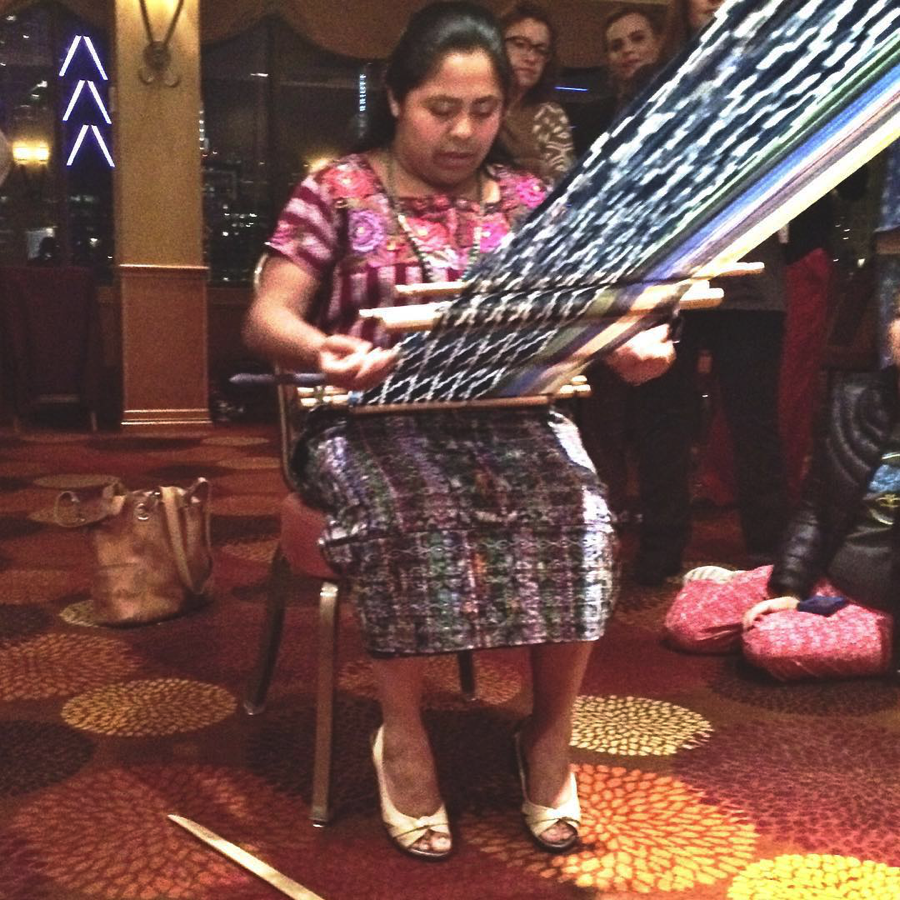
I recently returned from Austin, Texas where I had the privilege of meeting some of Noonday’s partner artisans. It’s incredibly humbling to meet these ladies. This is Ana:

Ana lives in Guatemala and learned the beautiful tradition of blackstrap loom weaving from her mother when she was just seven years old. As she grew, she became unsatisfied with the way she saw economic opportunities for women in her village. She sought out ways to make a difference. At the age of 28, she now owns a business and employs 30 female artisans. Ana partners with Noonday to make beautiful scarves. In this picture, you can see how each one is made. It takes five hours to weave one.

I’ve adopted a really powerful mental exercise that I learned from Melissa Russell, from the International Justice Mission, that she uses before she asks people for money to help her end human trafficking.

I imagine myself sitting down next to Ana, and telling her that I just don't feel confident enough to stand before you, because I’ve gained five pounds, and you have really pretty friends, and over 20 of them will be there, and I get really, really sweaty. It sounds ridiculous, doesn’t it?! 20 ladies who can use their purchasing power for good, so that Ana can hire more single mamas to do weaving. I want to talk to those ladies, and tell them all about Ana!
In spite of myself, and because of the women I represent, I’m an ambassador. And I work at it, so that I can do it better!

Here's what Ana has taught me, and there's something here for you, too. Ana knows she's enough. She was 20-years-old when she started her business. At twenty, she was giving single mamas the opportunity to weave in their homes, so that they can also take care of their small children! And here's the truth: 
You are enough! I am enough, and so is that pretty/thin/well-spoken/confident woman across the room. Her “enough-ness” doesn’t diminish my own. And we can elevate the worth of all women when we stop listening to the voices that tell us where we fall short, and start empowering those around us.
What if we all chose to live wholeheartedly, and pour into women around us, rather than listen to the voices in our heads saying that we don't measure up? When we stomp those voices out, and believe that we are enough, we have the power to change the world!

Ana has this dream of building her business to provide jobs for 100 women! Isn’t that incredible? I want to help her on her way to that goal today. Enter to win the scarf Ana was making by answering this question in the comments by 9PM CST February 15th: 
How do you empower women? 
We ALL empower the women around us--each one of you can add a voice to this conversation. I can't wait to hear what you have to say!