Showing posts with label travel. Show all posts

Monday, February 6, 2017

Look to the Lorax

The Lorax is on his stump behind me looking
less orange than usual in Universal Studios
"Unless someone cares a whole awful lot

Nothing is going to get better, it's not" 

- The Lorax

The Lorax was not my favorite Dr. Seuss book as a kid and it wasn't a favorite for either of my daughters when they were small. We were all more Green Eggs and Ham girls. I was way more into that aggravating Sam-I-Am than the stubby environmentalist shouting into the wind. The Lorax is one of those children's books that is written just as much for adults than for kids. Couched within whimsical drawings of imaginary creations like barbaloots and truffula trees is a post-apocolyptic tale meant to shock us into action. First published the year I was born (1971), it's a story about the dangers of personal and corporate greed towards nature. Perhaps even as a child, I sensed there was something different about this book. That it was pointing out some "inconvenient truth" long before Al Gore would ever come along with his big projection screen. Yet as my girls and I lean in to activism and become more aware of how humanity's destructive nature hurts the environment and ourselves (those in poverty most), we've taken to emulating the Lorax every time we find a likely stump to stand on anywhere in the world. It's become a symbol of standing up against all odds for what is right. The Lorax is clever, but it's not happy. It's inspirational, but mostly because it manages to make you feel angry about injustice and responsible for solutions at the same time.
"Lorax-ing" in Indianapolis

Indeed, the Theodore Geisel (a.k.a. Dr. Seuss) claims that the book came out of his own anger. "In The Lorax, I was out to attack what I think are evil things and let the chips fall where they might." The uncomfortable feelings of anger, frustration, and sadness are front and center in this story within a story. Those aren't really feelings we're used to being served up in books as children.

When the book opens, a boy in a desolate, polluted landscape gives an offering of odds-n-ends to hear the story of the lifted Lorax. In return, the Once-ler recounts the tale in which he himself is the villain. He relates how he came to a beautiful forest filled with incredible animals. He chose to use the unusual trees to manufacture "thneeds," garments which everyone wants, but nobody needs. Despite the protestations of the Lorax - who speaks for the trees and eventually all the woodland creatures - the Once-ler and his family create polluting factories and deplete the area of all the truffula trees. Only once everything is gone, spoiled, and utterly used up, do the Once-ler's family members leave and the Lorax stops fighting to lift himself away with only a sad, backward glance. 


"The Lorax said nothing. Just gave me a glance...just gave me a very sad, sad backward glance and he lifted himself by the seat of his pants." 


It's harder than the Lorax would have you believe
 to lift yourself by the seat of your pants.
The Lorax leaves only a stump behind with the word "UNLESS" carved on it. The Once-ler himself is despondent and ruined in the current timeline, left only with the mystery of the stump, but suddenly realizes what the riddle means. "UNLESS someone cares a whole awful lot, nothing will is going to get better. It's not!" He gives the boy the last truffula seed, passing on the responsibility to the youngster to regrow a forest in hopes that the animals - and maybe even the Lorax himself - might return. And then...it just ends... We don't know what happens to The Lorax, The Once-ler, the boy, or a single barbaloot.

"Lorax-ing" in Busan, South Korea
Perhaps the biggest reason that I didn't like the book as a child AND the reason that it may be the greatest Seuss book in the library, is the ending. It's sad. It's ambiguous. When we realize that WE are the boy, we know it's up to us to write the ending ourselves. It puts the responsibility to write end of the story in our own hands and we are uncomfortable with it. It's not exactly the children's book we want, but I think it's the children's book we need...generation after generation.

What do you think about The Lorax?

Is there another children's book you came to appreciate later in life for it's social messaging?




Thursday, September 1, 2016

The Strong Women of Jeju Island

This traditional Korean statue of a Jeju Island woman collecting water
also has working water spigots in this sculpture garden.
This summer, I travelled to South Korea with my daughter. Our guide (and Taekwondo instructor!) had the clever foresight to make Jeju Island our first stop. Located 130 km from South Korea's southern coast, the island is the country's largest island, smallest province and one of the New Seven Wonders of the World. It's perfect for relaxing when you need to readjust your internal clock. We were a few of the 9,000,000 tourists per year who visit this beautiful volcanic island. Geology aside, I found another aspect of the island's reputation to be particularly fascinating. You see, Jeju Island is known for the strength of it's women...leading to the nickname: "The Women's Island."

Wow! Who knew a place like that would exist in a country that struggles in regard to the status of women (particularly in business and politics)? Yet here is a pocket within Korean culture where the strength of women has openly celebrated for generations. On Jeju, women have long been a majority population and held economic power. An article from JejuWeekly.com explains:
"Historically, Jeju has been known as an “island of women” as females outnumbered males, worked alongside men in both agrarian and marine labor, and typically had economic control in their families. Under the rule of the Joseon Dynasty, which exalted Confucianism and firmly elevated men over women, the birth of a daughter was nevertheless a happy occasion in Jeju's coastal villages as she could become a “haenyeo” (diving woman) and thus earn money for her family."
A picture of mannequins in a museum since I was too far away
to get a good shot of the real women doing the real job.
Diving women? Yeah! For centuries, women on Jeju Island called "Haenyeo" have supported their families by harvesting conch, abalone, octopus, and other creatures by hand from the ocean floor. They are a symbol of female independence and strength.

Even today, you can see them diving using no breathing equipment even though they are down for around two minutes as deep as 10 meters underwater.  They dive with masks and lead weights (to make them sink faster) and a round flotation device to hold a net for the harvest. 

It's dangerous work. Between 2009-2014, 40 diving women died. According to the New York Times, the number of these "sea amazons" has dwindled to about 4500 from 26,000 in the 1960's with 84% of them 60 year old or older. Nowadays, younger women on Jeju Island prefer to work in hotels or rental car agencies for the tourism industry, but that wasn't available to their grandmothers. Diving offered the women respect and economic freedom to decide where family income was spent. Talk about a working mom!
A mannequin in a museum models the traditional dress of a
woman carrying water.
At first glance, the independence of the Jeju women sounded great to me, but further research revealed that things weren't quite so rosy. There is a local saying - "Better to be born a cow than a woman" - that speaks to the rough and physically grueling life they lived. Even if a woman was out of the water, she still couldn't escape the same job held by millions upon millions of girls and women since the beginning of time...hauling drinking water.


The real deal. These ladies in the photo aren't models!

Before running water was available, islanders obtained drinking water from rain or coastal springs. Women carried water on their backs using earthenware jars strapped in bamboo baskets. Until the 1960's, water in mid-mountain villages (where the water supply was scarce) was collected by girdling a large tree with a belt fashioned of grass, which led the water flowing down the trunk into a jar. 

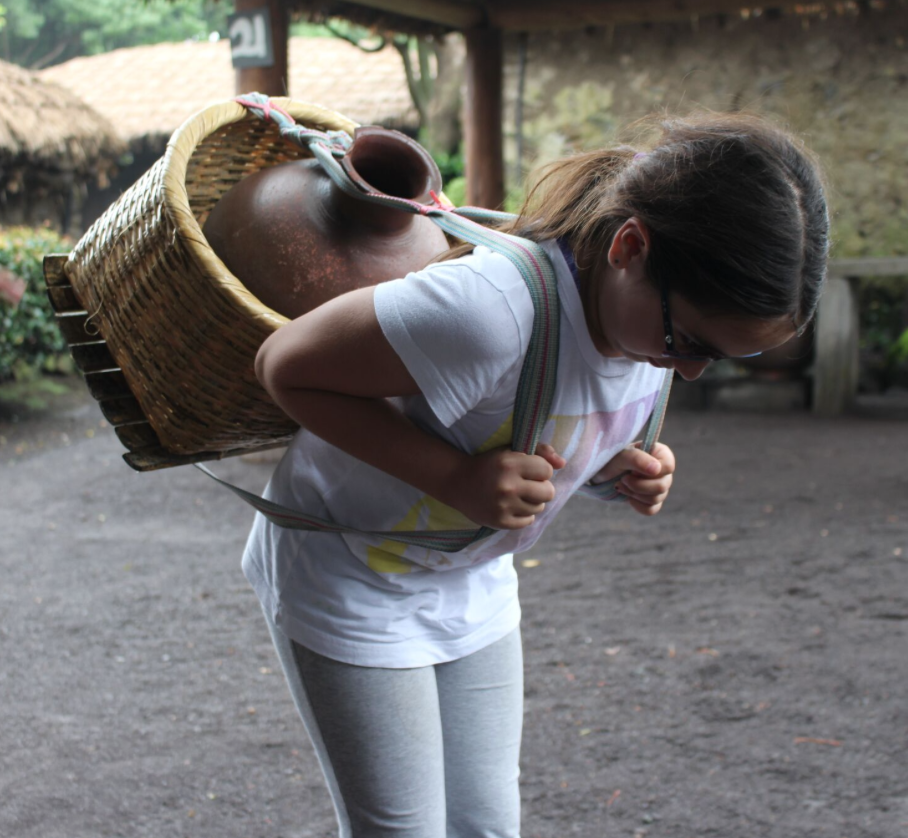
This image is so important to the culture that stone statues around the island recall the strength of the women who carried the life-sustaining water on their backs for years. My daughter got to try carrying one of the traditional jars herself. She says the jug itself was pretty heavy even when it was completely empty...and she is a strong Taekwondo black belt herself!

My daughter tries out a water jug her size. 


I'm glad I got a chance to learn about the Jeju women alongside my girl. It helped give us a historical perspective of women in a small community within a country we hadn't visited before. 

Gender equality is #5 on the list of the Global Goals for Sustainable Development. We simply cannot end poverty without it. Because the basis of so many economies lies on the backs of so impoverished women, we owe it to ourselves to learn about gender roles around the world and support organizations and policies that help women lift themselves and their families up on a path to independence and respect. 


Here are just a few ways to be part of the solution:
  1. Join or donate to BRAC: BRAC takes a holistic approach to ending poverty in several ways including: microfinance, education, healthcare, gender justice and empowerment. They give women the tools they need to take control of their own lives. 
  2. Join or donate to Girl Rising: Girl Rising uses storytelling to inspire action that gets girls into classrooms worldwide. Watch a film on their website and tell your community about why girls' education matters. Sign up to be informed about advocacy actions you can take to help.
  3. Donate to Water.org: Water.org helps bring clean drinking water to communities so that valuable time and energy is not lost when women and girls haul water for their families' daily use. Donating to them provides water infrastructure and supports the advocacy they do as an organization (although I don't think they have an action alert system for citizens to advocate)