Showing posts with label gender equality. Show all posts

Monday, March 6, 2017

Gaining Inspiration from #Malala


Today, I'm honored to post the writing of a guest blogger, Shruti, a good friend of my daughter. She wrote the following piece about Malala Yousafzai for her 7th grade class. I was moved by her last paragraph about how she has been inspired by Malala to help girls around the world to access education. She told me about her family trip to India, where she got to visit a school for girls who had previously been denied education by their families. Even though their families did not put value on education for girls, their community came together to create the school and put pressure on the their parents to let them come.

Shruti and the members of RESULTS St Louis visiting
the aide of U.S. Representative Ann Wagner
Shruti got a chance hear firsthand about how the students felt about their new opportunities. One student still cries every morning when she arrives because she is so grateful to be getting the education she thought was out of her reach. Another girl used to actually dream at night about how it would feel to hold a pencil in her hand...she never thought she would have that chance in real life! I was so moved by these stories that I asked her to tell these stories to an aide in the office of our U.S. representative. I'm so happy she came with our RESULTS group to speak out. She bravely told her story with sincerity and passion, helping us make the case for why we want our U.S. representative to fund the Global Partnership for Education at a level of $125 Million for fiscal year 2018.

To learn more about the value of educating girls and the life of Malala, please enjoy Shruti's essay...


A Girl With Knowledge : A Girl with Power

by Shruti, 7th grade
With every extra year of quality education, a girl earns 20% more as an adult. There are millions of girls around the world who don’t get to learn to read or write because they are forced to work around the house and get married early. Many others simply can’t afford school because of war or poverty in their countries. A few years ago, a young girl named Malala Yousafzai began working towards providing girls around the world with quality education..

Speaking Out

In 2009, Malala had started writing a blog for the BBC Urdu service under a pseudonym. Most of her blog posts were about Malala’s opinion of the Taliban banning girls from going to school and destroying school buildings. A few months afterwards, she was featured in a New York Times documentary, and was revealed as the author of the BBC blog.

Threatened

Malala, and her father, Ziauddin Yousafzai, began receiving death threats from the Taliban. Two years later, in 2011, Malala received Pakistan’s first National Youth Peace Prize. Seeing her progress and recognizing the fact that Malala was gaining popularity, the Taliban  leaders  decided  to  kill her.  

Attacked

On October 9, 2012, young education activist Malala Yousafzai was shot by the Taliban for speaking out about girls’ right to education, while she rode her bus back home from school.
When Malala was shot, people all around the world rose to her defense, and began rallying for girls’ education with more enthusiasm than had ever been witnessed for this cause.

Sticking With Her Dream

Flash forward to early 2013 — Malala gave her first speech after recovery at the UN. Even after being shot, and going through a long recovery, Malala said that “Education is the only solution. Education First.”  Recently, on her eighteenth birthday, Malala opened a school in Lebanon for Syrian refugee girls.

How Many Girls Don’t Receive The Education They Need?

As stated on the Malala Fund website, 32 million girls eligible for elementary through middle school are still out of school around the world. School enrollment rates for girls have improved over the past ten years, yet more than 30 million girls between ages 9 and 15 are still out of school today. Most of them will never enter a classroom.
Another 98 million girls are missing out on secondary education. Millions more are missing out on the final years of secondary schooling but are not being counted. Girls are often under pressure to drop out of school, even if they have completed basic education.

The Benefits of A Quality Education

According to “Girls' education: A lifeline to development” found on UNICEF’s website, studies from a number of countries suggest that an additional year of schooling would increase a woman's future salary by about 15 %, compared with 11 % for a man.
Educated girls are more likely to avoid getting married as a child, and usually have fewer children than girls who don’t have access to education.

How Many Have We Actually Helped?

According to Dr. Geeta Rao Gupta, former president of the International Centre for Research on Women, the education target has made an important difference in the lives of girls and women.
“Action and investments of dollars into women’s constraints and needs has increased. And that has resulted in some progress.” said Dr. Rao Gupta.invest-in-girls-info-5232014.png
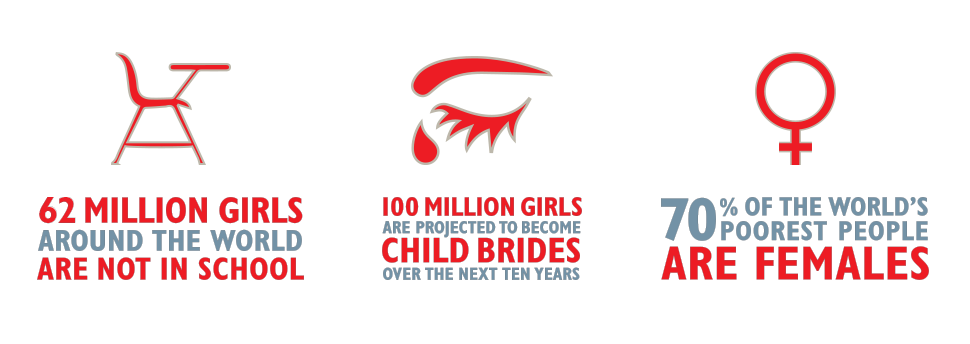
“The girls who are left behind are the ones who are most in need – and these are poor girls, those who belong to minority populations within their countries and those who live in rural areas,” Dr. Rao Gupta added. “Unfortunately, they are the ones who still have not received the benefits of the various investments made in most countries around the world.”

What Can We Do To Help?


Even a small contribution would help us reach the point where every girl has access to good education. Hosting small fundraisers, donating towards the cause, or even rallying for it are ways that would be beneficial. Many non-profit organizations write letters to the governments of multiple developed countries, asking them to step in and try to improve the accessibility to education for girls around the world. Together, we can achieve our goal of providing every girl with a quality education.
                 We are so fortunate to receive education and get a chance to make our own future. Many children around the world never get that chance. I think about all those times I have complained about homework assignments. I think of all those times I have whined about studying for a test. And I realize what an important opportunity I have — I can work towards going to my dream college and I have a job I have always thought about having. After writing this article and reading about girls all around the world who dream of holding a pencil and a notebook, I know for sure that I will never forget to appreciate my education and will try my best to contribute towards girls’ education.


Thursday, September 1, 2016

The Strong Women of Jeju Island

This traditional Korean statue of a Jeju Island woman collecting water
also has working water spigots in this sculpture garden.
This summer, I travelled to South Korea with my daughter. Our guide (and Taekwondo instructor!) had the clever foresight to make Jeju Island our first stop. Located 130 km from South Korea's southern coast, the island is the country's largest island, smallest province and one of the New Seven Wonders of the World. It's perfect for relaxing when you need to readjust your internal clock. We were a few of the 9,000,000 tourists per year who visit this beautiful volcanic island. Geology aside, I found another aspect of the island's reputation to be particularly fascinating. You see, Jeju Island is known for the strength of it's women...leading to the nickname: "The Women's Island."

Wow! Who knew a place like that would exist in a country that struggles in regard to the status of women (particularly in business and politics)? Yet here is a pocket within Korean culture where the strength of women has openly celebrated for generations. On Jeju, women have long been a majority population and held economic power. An article from JejuWeekly.com explains:
"Historically, Jeju has been known as an “island of women” as females outnumbered males, worked alongside men in both agrarian and marine labor, and typically had economic control in their families. Under the rule of the Joseon Dynasty, which exalted Confucianism and firmly elevated men over women, the birth of a daughter was nevertheless a happy occasion in Jeju's coastal villages as she could become a “haenyeo” (diving woman) and thus earn money for her family."
A picture of mannequins in a museum since I was too far away
to get a good shot of the real women doing the real job.
Diving women? Yeah! For centuries, women on Jeju Island called "Haenyeo" have supported their families by harvesting conch, abalone, octopus, and other creatures by hand from the ocean floor. They are a symbol of female independence and strength.

Even today, you can see them diving using no breathing equipment even though they are down for around two minutes as deep as 10 meters underwater.  They dive with masks and lead weights (to make them sink faster) and a round flotation device to hold a net for the harvest. 

It's dangerous work. Between 2009-2014, 40 diving women died. According to the New York Times, the number of these "sea amazons" has dwindled to about 4500 from 26,000 in the 1960's with 84% of them 60 year old or older. Nowadays, younger women on Jeju Island prefer to work in hotels or rental car agencies for the tourism industry, but that wasn't available to their grandmothers. Diving offered the women respect and economic freedom to decide where family income was spent. Talk about a working mom!
A mannequin in a museum models the traditional dress of a
woman carrying water.
At first glance, the independence of the Jeju women sounded great to me, but further research revealed that things weren't quite so rosy. There is a local saying - "Better to be born a cow than a woman" - that speaks to the rough and physically grueling life they lived. Even if a woman was out of the water, she still couldn't escape the same job held by millions upon millions of girls and women since the beginning of time...hauling drinking water.


The real deal. These ladies in the photo aren't models!

Before running water was available, islanders obtained drinking water from rain or coastal springs. Women carried water on their backs using earthenware jars strapped in bamboo baskets. Until the 1960's, water in mid-mountain villages (where the water supply was scarce) was collected by girdling a large tree with a belt fashioned of grass, which led the water flowing down the trunk into a jar. 

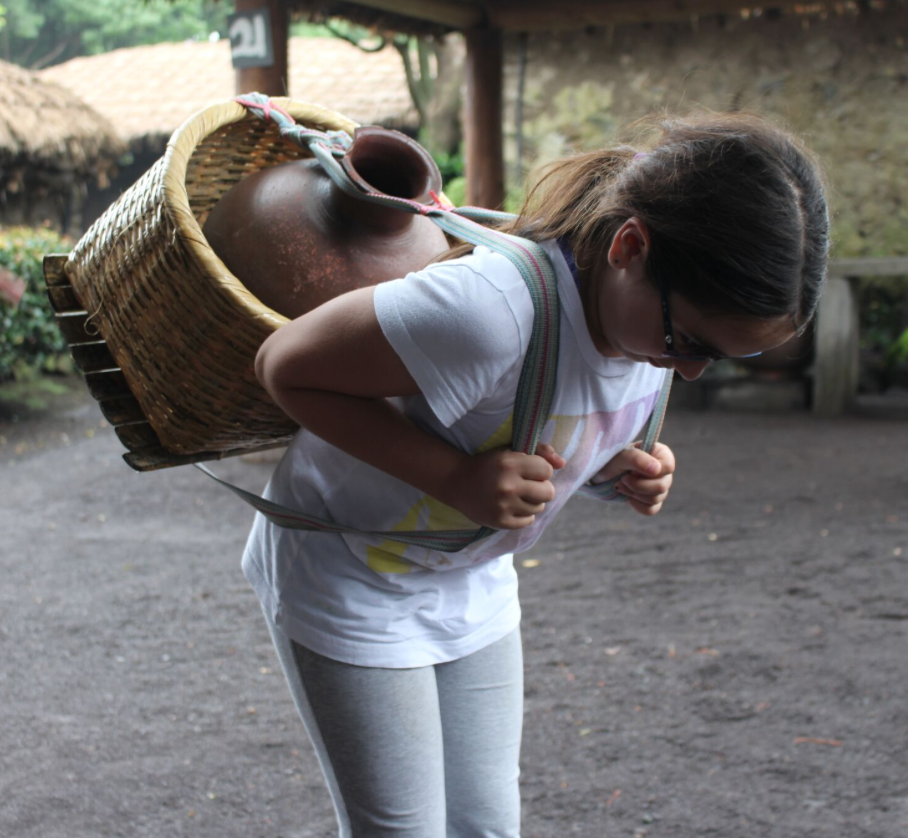
This image is so important to the culture that stone statues around the island recall the strength of the women who carried the life-sustaining water on their backs for years. My daughter got to try carrying one of the traditional jars herself. She says the jug itself was pretty heavy even when it was completely empty...and she is a strong Taekwondo black belt herself!

My daughter tries out a water jug her size. 


I'm glad I got a chance to learn about the Jeju women alongside my girl. It helped give us a historical perspective of women in a small community within a country we hadn't visited before. 

Gender equality is #5 on the list of the Global Goals for Sustainable Development. We simply cannot end poverty without it. Because the basis of so many economies lies on the backs of so impoverished women, we owe it to ourselves to learn about gender roles around the world and support organizations and policies that help women lift themselves and their families up on a path to independence and respect. 


Here are just a few ways to be part of the solution:
  1. Join or donate to BRAC: BRAC takes a holistic approach to ending poverty in several ways including: microfinance, education, healthcare, gender justice and empowerment. They give women the tools they need to take control of their own lives. 
  2. Join or donate to Girl Rising: Girl Rising uses storytelling to inspire action that gets girls into classrooms worldwide. Watch a film on their website and tell your community about why girls' education matters. Sign up to be informed about advocacy actions you can take to help.
  3. Donate to Water.org: Water.org helps bring clean drinking water to communities so that valuable time and energy is not lost when women and girls haul water for their families' daily use. Donating to them provides water infrastructure and supports the advocacy they do as an organization (although I don't think they have an action alert system for citizens to advocate)


Saturday, August 27, 2016

Rainbow Parfaits for #Global Goals

It's true that sometimes I am overly ambitious. I know this. I claim that my life is too short to do one thing at a time, so I multitask to a ridiculous extent and manage to work in a poverty-fighting action or lesson into almost everything I do. Sometimes to great success. Other times...well, let me tell you the story of the End of the Rainbow Parfaits.

I was browsing through Pinterest one day with my eye out for a fun dessert I might make with my daughter and her friends for an upcoming slumber party. They'd been in a baking phase and I wanted to indulge them a bit. This is when I stumbled upon the End of the Rainbow Parfaits.
Photo from Tablespoon.com
Now, I know most moms wouldn't look at these delicious treats and say "Hey, that looks like a good lesson about the Global Goals!!!" But I'm weird and that's exactly what I thought. See, when I saw that picture, my mind when straight to this infographic...
The Global Goals for Sustainable Development, which I previously wrote about here, are 17 goals for the world that will help us do three things in the next 15 years: end extreme poverty, fight inequality and injustice, and fix climate change. It's up to us as global citizens to choose which ones we personally want to work on to get there. Each goal has a color in the graphic, so I thought that it would be neat to make these parfaits and allow kids to choose the color representing the issue they felt most strongly about. Only want to help "Life Below Water?" Cool. Yours can be all blue. I can never choose just one and like to work on global health (green), life under water (blue), clean water (light blue), education (dark red), and poverty in general (bright red).

I wanted to make these with my daughter's friends and give them the message that THEY get to choose in life what THEY want to work on. Too often, we just spoonfeed kid the idea that they have to do something and give them a something that we personally want to do. In real life, we have a choice.

In the middle of the prep, I got a call from my good friend Jennifer Burden, founder of World Moms Network. I told her I was getting kind of aggravated while I was getting ready for a slumber party and putting together the ingredients for this pretty ambitious dessert/craft. She said something like, "Do you ever just do anything just for fun?" I laughed and (joking-not-joking)said something like, "I don't think so. Please help me. It's a problem!" And it was! I was stressing out about the party anyway. I had no business trying to add a poverty lesson into the mix!!! Why was I pushing myself into an "Advocate to Aggravate" campaign?

Sigh. Well, Jen talked me into a better mood and we proceeded with the craft. Let's see how it went shall we?

STEP 1: Mix up refrigerated sugar cookie dough with eggs, vanilla, and food coloring. For simplicity, I did not make 17 different colors.


STEP 2: Spoon the colored batter into cupcake cups.


STEP 4: Bake 'em up! Use this baking time to explain the Global Goals to your helpers and tell them to think about what colors and goals they would like to work on.

STEP 5: Remove from oven and admire how well you are doing so far.

STEP 6: Crumble up the colored cupcakes into separate bowls.

STEP 7: Spoon in a chosen color, cover with whip cream, repeat until satisfied. And VOILA!
U

hmmm...okay, so they didn't EXACTLY turn out the way they looked on Pinterest, but on the whole I think we...

NAILED IT!


So, yeah. It turned out to be a laughable mess. We won't be doing this for any bar mitzvahs or anything, but the girls had fun and they got some global learnin' along the way. I was not sorry we tried!! If you try it, tell me how it goes!