Showing posts with label EPIC. Show all posts

Tuesday, August 19, 2014

Advocacy Made Easy: Writing a Blog Post

You may have seen my past posts in my Advocacy Made Easy series. (If you want to see them, type "Advocacy Made Easy" into the search bar of this blog) I'll admit up front that this particular action - writing a blog post - isn't as ready-made for step-by-step instructions as other advocacy actions. It requires creativity, introspection, and a willingness to put your views out into the public that many other actions don't.

I'm still stumbling along in this journey to create compelling posts, but here are a few lessons I've learned that I can share with you about creating blog content.

EPIC Format Still Works
I use the EPIC writing format for writing letters to Congress and letters to the editor. There's nothing wrong with using this tried and true method for a blog post. A blog tends to be more free flowing than a formal letter, so it's okay if you just want to write 6 or 7 haikus about your topic. Nevertheless, for informing readers and asking them to take an action, nothing beats a good EPIC piece of writing. "EPIC" is a handy mnemonic for remembering an order of statements to build your case for an action and engage your reader. Here it is:

Engage: Grab the reader's attention with a question or a startling statement. You could use a surprising statistic or a question. 
Problem: State the problem that you want the reader to address. 
Inform (or Illustrate): Inform the reader of the solution or illustrate how the solution can help. 
Call to Action: CLEARLY state what you want the reader to do. It's best if you can do it in the form of a question that should be answered with a "yes" or a "no."

THINK Before You Post
There are plenty of bloggers making names for themselves by being edgy, negative, or snarky. However, my advice to you, especially if you are just starting out and haven't found your voice yet, is to play it positive. It seems like the online universe trends toward the negative side of things. Isn't there enough name calling and disrespect out there? Why add to it? Remember, once you put something negative and nasty out there, you can't take it back once it starts being shared and re-tweeted.

I found a sign in the hallway at an elementary school and thought that its message is even more applicable to bloggers than school children. It encourages kids to think before they speak and ask themselves about what they are about to say: Is it true? Is it helpful? Is it inspiring? Is it necessary? Is it kind?

I strive to hold similar standards in my blog posts. I want this blog to be uplifting and inclusive, so I also give consideration to "Who might I be alienating with the way this draft is written?" I know I don't always get it right, but stopping to think before posting helps a great deal.

Use Pictures (your own pictures!)
Pictures are a great way to get someone to click on your blog and hold attention. They don't even have to be award winning photography. Just something to give the brain a break from a solid wall of text. Case in point: In the bullet suggestion above, I could have just listed out the bullet points of the "Think Before You Speak" poster. But it was more interesting looking at the quilt-like bulletin board that a teacher spent a good amount of time putting together, wasn't it? I've taken pictures of legos spilled on my floor and heaps of my own dirty laundry to make my points. The main thing is that you own the pictures you use or credit the person who does own the photo (ideally with his or her permission). You can also purchase stock photos on websites for not much money if you wish. Sometimes if I don't have a good photo, I might simply draw a quick sketch like this one I used on a blog about sadness.
http://endpoverty-ccyl.blogspot.com/2015/07/sadness-is-underrated-emotion.html

Be Sincere and Find Your Own Voice
Frank Gilbert, English teacher and fellow RESULTS advocate, guides his students in the art of finding their own writing styles. He tells them, (paraphrased) "If anyone ever tells you that they can hear your voice when they read your writing, then you know you have found your genuine writing voice." When I began this blog, my own writing was quite stilted and - frankly - extremely boring. If you don't believe me, you can read my post from 2007 about the Farm Bill. Or - better yet - don't bother unless your having difficulty sleeping and want to be lulled to unconsciousness. Over time, I found that many more people respond to my posts when I write as if I'm writing an email to a friend. Sure, a post should be more strict about grammar (see Weird Al Yankovic's "Word Crimes" if you don't understand why) than your twitter feed. So, be casual while also being correct. Please also accept my apologies for the unintentional typos you may be reading over in this very post. Additionally, when I became more authentic in sharing who I am - a nerdly stay-at-home mom of two - and shared my opinions through that particular perspective, my posts became more interesting to more people.

Like I said, I'm still growing and learning. If you have more pieces of advice for new (or old) bloggers, please share them in the comments. I'd love to hear it!
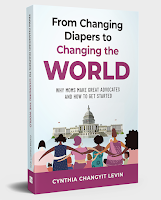

Image: Book cover

Buy an autographed copy of "From Changing Diapers to Changing the World: Why Moms Make Great Advocates and How to Get Started" at my website www.changyit.com or order it from Amazon, Barnes and Noble, or any independent bookstore!

Monday, June 2, 2014

Advocacy Made Easy: Teaching Kids to Write to Congress


How far did you walk for your last drink of water? Was it clean water? Safe to drink? How much water would you drink if you had to walk for hours to fill up a canister for your whole family's daily water supply?

These are questions 4th graders at Park View School in Morton Grove, IL have been pondering for the last few weeks. Guided by their teacher, Debby Schmid, they read A Long Walk to Water by Linda Sue Park. It's a great book to introduce elementary school students to some of the challenges their peers in Sudan are facing right now. The story, brilliantly told in alternating sections, tells the tale of two Sudanese eleven-year-olds in different times (2008 and 1985). The fictional girl based on current life in Sudanese children, Nya, spends hours each day carrying water making two trips to a pond every day for her family, deprived of education. The boy, Salva, is a real person...one of the "Lost Boys of Sudan" - survivors of Sudanese civil war - who had to flee his country on foot looking for his family and safety. Water is a theme and focus of the book.

Giving some context of how hard it is for a bill to become a law
before showing the SchoolHouse Rock video, "I'm Just a Bill"
My portion of the program came when the students were ready to ask that critical question: "What can WE do to help people have water?" Ms. Schmid and I wanted these gifted youngsters to dive in to make a big difference and also learn some great lessons for both writing and life. We created a field trip to the Morton Grove Public Library to fill up empty water jugs and carry them back. At the library, they would learn about how the U.S. helps people in developing nations gain access to clean water and what our role is as citizens to help make that happen. 

Right now, there's a bill in Congress called the Water for the World Act of 2013. It's an update of an law that directs how U.S. foreign aid helps people in extreme poverty get access to clean water and sanitation. The Water for the World Act of 2005 said we should focus water and sanitation assistance toward the countries, locations, and people with greatest need. Yet countries with the least need receive more funds than those with greatest need. This new bill will help make sure that the people who need the most help will get the most help...without an increase in funding!

With the help of the all-time BEST training video for explaining how a bill becomes a law, the 1975 SchoolHouse Rock "I'm Just A Bill" segment, I showed them that the World Water Act is at the point where we, as citizens, can help it to be passed in the House of Representatives by writing to our U.S. representative and asking her to co-sign the bill.

I taught them the very same method for letter writing that I teach to grown-up RESULTS volunteers. When writing a letter to Congress, it helps to follow this tried and true "EPIC" format to create a clear, effective, one-page handwritten letter. This is what EPIC stands for:

No joke...these kid-letters are gonna be EPIC!
Engage: Grab the reader's attention with a question or a startling statement. You could use a surprising statistic or a question.

Problem: State the problem that you want the reader to address.

Inform (or Illustrate): Inform the reader of the solution or illustrate how the solution can help.

Call to Action: CLEARLY state what you want the reader to do. It's best if you can do it in the form of a question that should be answered with a "yes" or a "no."

This same format can be used to create a "laser talk" or "elevator pitch" for your issue, but in this case, we encouraged the kids to write just one or two sentences for each section to create their letter. I had them tell me about what they learned from reading A Long Walk to Water and watching videos from the Water for South Sudan organization, so that the letters would be truly their own creations.
The kids gave me their own bullet pints to use for the "Problem" portion of the EPIC format.


z
Carrying water through neighborhood streets
I was impressed by these kids asking great questions like "If Jan Schakowksy cares about poverty so much why do we need to write her letters?" (Answer: Because hundreds of bills are introduced every year and even her awesome staff can't keep track of everything!) and "What kind of people wouldn't want to help people get water...evil people?" (Answer: Ummm...more like people that don't fully understand the issue or ones that are worried about running out of money. And evil people, I guess.)

After turning in their letters, we loaded up the kids with their filled water jugs and began the 0.7 mile trek back to school, which took about 20 min. All the kids were very aware this was only a fraction of the distance the children walk in Sudan. The trip in the book took a quarter of the day for a round trip on roads in disrepair that must be travelled barefoot.

I feel compelled to point out that the girls are not sad 
and miserable. They're just looking down at the letters.


Last, but certainly not least, came the step of delivering our letters to the local congressional office of U.S. Representative Jan Schakowksy. It was a simple drop-off appointment, but it does make a big impression to hand over 22 letters from school children. I would be very surprised if we don't hear from her office very soon! 


Here was our outline for the program for anyone who would like to duplicate this program in their school:
  • Walk to the library with empty jugs
  • Explain the role of an advocate or activist 
  • Talk about what it's like to meet with members of Congress
  • Explain what a bill is and the difficult process for it to become a law
  • Show SchoolHouse Rock "I'm Just a Bill" video
  • Tell them about the World Water Act and explain where their letters fit in the process
  • Explain where we are in the process and that they will be writing letters
  • Teach the EPIC format of letter writing
  • Have them tell me their own talking points they've learned and write them on the board that they can use in their letters.
  • Pass out an example handwritten by a child
  • Have kids write their own short letters
  • Fill bottles of water
  • Take pictures to send to parents and Congresswoman
  • Walk back to school
Please take a moment to write your own letter to your representative about the World Water Act using this website for talking points and a sample letter! If you take on this program at your school, I'd love to hear about it. Please leave a comment with your experience. Good luck!


Image: Book cover

Buy an autographed copy of "From Changing Diapers to Changing the World: Why Moms Make Great Advocates and How to Get Started" at my website www.changyit.com or order it from Amazon, Barnes and Noble, or any independent bookstore!