Wednesday, April 21, 2021

Snow Days for Advocates?

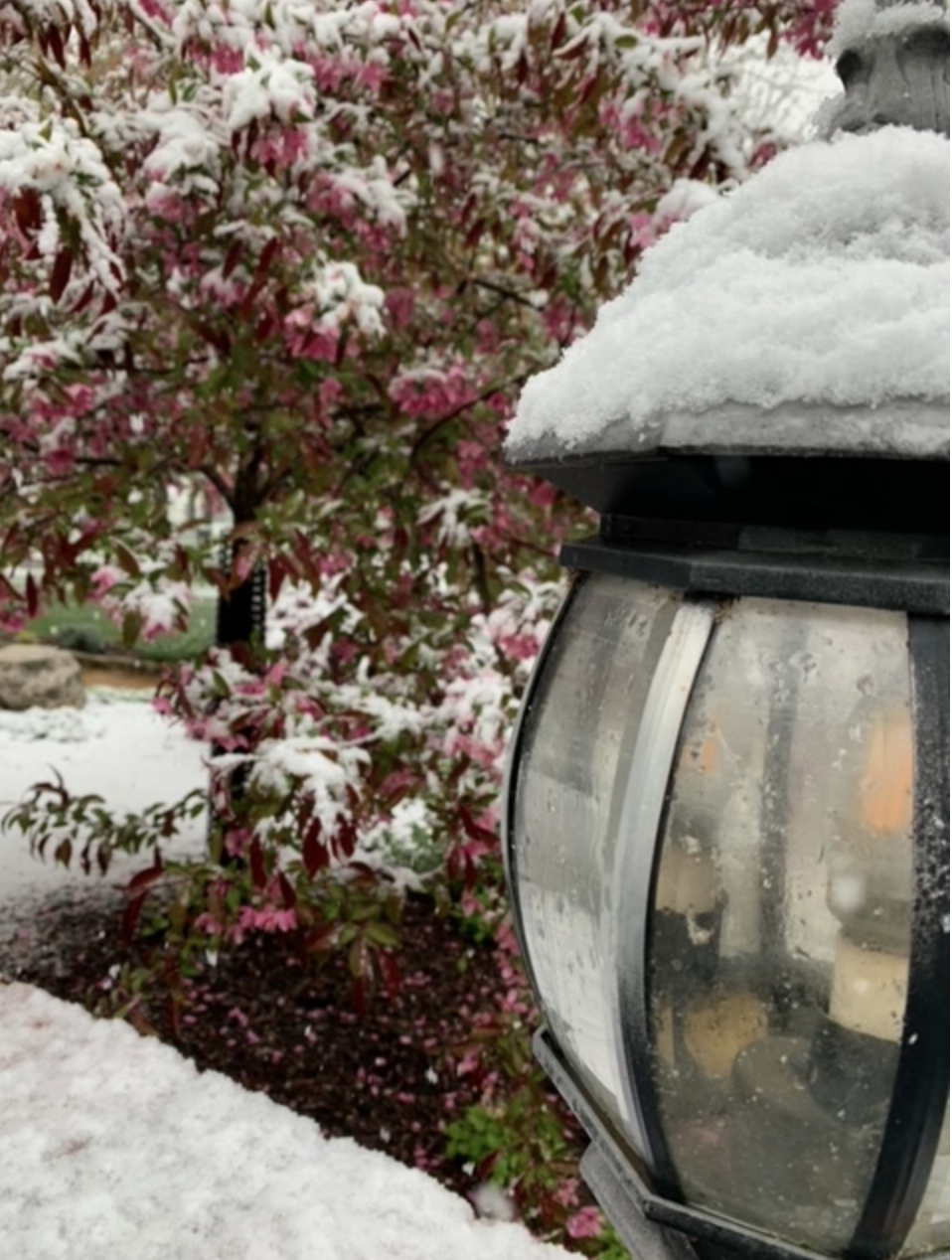
Snow covering a lantern and a tree with pink blossoms.

Yesterday afternoon, my activist daughter and I talked about the triple-guilty verdict in the Minneapolis trial of Derek Chauvin yesterday. I was in a mental place of expressing relief for a verdict my cynical heart had predicted to go the other way. She was in a place of continuing the fight for justice. She asked me (this is my paraphrasing of her question), “What difference does this verdict make in our actions? There is still so much to do.”

She’s right. We still live in a broken system overshadowed by oppression and white supremacy. But I tried to describe how on-the-edge this has felt for mom-friends with Black children. It’s hard for me to explain it when I can’t experience the depth of their anxiety myself. But I do know a thing or two about the draining long-term effects of activism.

Snow Days for Advocates

Snow upon pink spring blossoms.

It hurts to advocate for years and years on a thing that never really seems to change whether you're working on climate, tuberculosis, or gun violence. It’s even worse for my friends who feel real and active fear when their Black children are quickly growing into Black teens. I tried to make a comparison that a major trial verdict like this is like a Snow Day for advocates. Remember that feeling when you have a ton of schoolwork, but then you wake up one morning to heavy snow blanketing the ground? When you hear that school cancellation announcement, you KNOW you’re still responsible for all the work. But for a few hours, you can lay aside your burden and not fight that particular fight.


Snow on a blossoming tree against a
pine tree in the background.

A Killing Frost

As I said those words, a rare St. Louis April snow fell amidst our spring blossoms. The Snow Day seemed like a suitable metaphor. Then, tweets started coming in from Ohio about the police shooting of 15-year-old Ma’Khia Bryant. They reminded me we weren’t even a week away from the killing of Daunte Wright by a police officer at a traffic stop in Minneapolis. It changed the way I looked at the snow on the flowers. Suddenly, it seemed more like a killing chill threatening the beauty of progress in the season.

I sat watching the quiet, falling flakes. The hopeful thought entered my mind that the snow might indeed kill those blossoms, but it won’t kill the trees. Their roots, like the grass on the lawn, run deep. There’s a reason we call activism from regular folks “grassroots advocacy.” You can mow the grass down or you can freeze the blades. But if the roots are deep and healthy, grass will come back again and again. Some movements are young and fragile, like the young pea shoots in my backyard garden. We must nurture and protect them, so they can later withstand the coming heat of summer. (I covered the peas up with tarps in the morning before the snow)

We’re Both Right

Today, I’m more of my daughter’s mindset. I think of end of the Thurgood Marshall biopic, “Marshall,” where he didn’t even stick around in town to hear the verdict of the big case because he was already in another town with another trial. We must keep moving ahead as a country. Yesterday, however, I needed to lean into the relief I felt. Especially as we get older and see more wins and losses, we need to learn to stop and take a pause when we see accountability or progress. It strengthens us in our long journey toward justice.

Snow on purple flowers.

Wednesday, March 31, 2021

Review: "Thou Shalt Not Be a Jerk" by Eugene Cho

The cover of "Thou Shalt Not Be A Jerk" along with my
trusty highlighter and a paper for notes

"Thou Shalt Not Be a Jerk: A Christian's Guide to Engaging Politics" Could there be a more perfect title for a book about being a Christian in political America? With humility and humor, Rev. Eugene Cho brings us a book sorely needed by both Christians who have entrenched themselves with a political party and those who have entirely disengaged from politics altogether. 

We might think it’s a pretty obvious imperative: “Don’t be a jerk.” But Rev. Cho addresses how the anonymity of online interactions and the dehumanizing nature of extreme political views promote jerky behavior..behavior that can be harmful or even deadly when it translates into government policies. So many of us - including me, including Rev. Cho - fall prey to negative human tendencies. It’s easy to get carried away with political fervor when you’re confident your candidate or party is aligned with your religious values. In reality, no party is completely aligned with any religion. To combat this part of our nature, he encourages Christians to center ourselves on Christ. 

Rev. Cho offers insight from his experience as a pastor to help Christians examine their motivations and approach to politics. His writing shows why he was a superb choice to lead Bread for the World, a leading Christian advocacy group. His non-partisan, relational approach to talking about politics is refreshing and needed today.  

I don’t talk about my faith often on this blog, but it is the part of me that led me to advocacy. I was fortunate Bread reached me with the message that I have an obligation to take part in my democracy and ensure that our country feeds hungry people and protects the vulnerable. Cho elaborates on that idea:

“Hear this well: Politics matter. They matter because politics inform policies that ultimately impact people. When I read the Bible, it’s emphatically clear that people matter to God- including and especially people who are marginalized, oppressed, forgotten, and on the fringes of our larger society.”

One of my favorite things about this book is how it explores practical ideas others have tried in order to break down barriers that divide people politically. One was the “Make America Dinner Again” (MADA) movement. It was a grassroots idea to facilitate potluck dinners between people of different ideological backgrounds. Participants were united in the notion that they were tired of divisive politics and committed to actively listening to the other dinner guests. The stories of past participants and Rev. Cho’s own experience trying it gives me hope for what can happen when diametrically opposed people concentrate on a desire to make things better.  

“Listening” and “relationship” are big themes in this book, which is why it’s so appealing to me. These very simple ideas can be very hard to live out. Connecting them back to the center of my faith raises the importance of seeking commonality, especially when I don’t want to do it at all.

Of course, as an advocate, I love the part of the book when he talks about advocacy and voting as ways to live out our faith. But I was already sold on that part. For me, the most valuable passages are the ones that speak to my own human struggle I face when I feel like someone is being a jerk to ME. So, I’ll leave you with a passage I should probably tape onto the monitor of my computer for a helpful reminder whenever I go out into the wilderness of social media:

“We must learn to be civil with one another, including those we disagree with - even political candidates. This is one of the great challenges in our culture today. We are called to love one another, including those who don’t look like us, feel like us, think like us...or vote like us. 

In voicing and pursuing our convictions, we not only represent ourselves as followers of Christ; we represent Christ. This is not to suggest we can’t have fierce convictions, but there is a distinction between being passionate about our conviction and being mean spirited and jerks. This is worth repeating: be careful not to dehumanize those you disagree with. In our self-righteousness, we can become the very things we criticize in others. 

There is a difference. 

I’m all for contending for convictions, but let’s not be jerks in the process. Be respectful. Be mature. Be wise. The world doesn’t need more jerks for Jesus.” 


Wednesday, March 24, 2021

Surprise! It's #WorldTBDay

Kate O'Brien, Alexis Cosse, and Cindy Levin share a
zoom screen to meet with Congress on World TB Day

Have you ever almost forgotten to observe a holiday? Like, it comes around every year, but sneaks up on you when you're not paying attention? Those times can leave moms scrambling to reserve a Passover brisket or making a late-night CVS run to fill some last minute Easter baskets. Well, I've got my eye on those two events, but today snuck up on me. Today is World TB Day!

Luckily, my RESULTS colleague Crickett Nicovich asked me to fill in for her World TB Day congressional meetings because she (having NOT forgotten the annual event) was double-booked. No problem! I did not want to forget to take action on this day, which brings attention to one of the most neglected diseases on Earth. Among all the global health issues I cover, tuberculosis is the one I most want to talk about in this moment. Why? Because TB sits at the intersection of great need, great injustice, and great opportunity.

Why does TB have its own day?

The UN SDG logo with 
"End TB" in the center

Even though most Americans think the world got rid of TB long ago, it is a leading infectious disease killer. Only in November 2020 did COVID-19 surpass tuberculosis. Nonetheless, TB is still reigns supreme in low and middle-income countries. In 2019, an estimated 10 million people were sickened by this bacteria-driven illness and 1.5 million were killed by it. Now? Well, the data isn't all in yet, but modeling suggests disruptions in diagnoses and care during the pandemic have caused an increase that will cause an additional 6.3 million to contract active cases and an additional 1.4 million to die in 2021.

Like COVID-19, tuberculosis is an airborne disease. Unlike COVID-19, there is no effective vaccine for adults yet. The most common vaccine used for it is most effective for children, but that means TB hits people ages 15-45 (young adults, parents, and breadwinners) particularly hard. 

So, why doesn't anyone talk about TB the way we focused on COVID-19? Because it is a disease of poverty. Even though it is present in wealthy countries, it doesn't affect their citizens very much at all. This is the "injustice" part. It runs rampant in low-income countries and has hot-spots in impoverished areas of middle-income countries. When a disease no longer affects wealthy countries, our governments tend to ignore problems that greatly affect the global South, Black and Brown populations, and impoverished nations. 

It is both a major consequence and a driver of poverty. The reason RESULTS got involved at all with tuberculosis years ago is because the organization was working on microcredit loans for women in extreme poverty. The biggest reason women couldn't pay back loans was because TB sickened them and they couldn't work. If we can stop TB, we can remove a major barrier keeping millions of people trapped in poverty and allow them to rise out of poverty with dignity.

TB in the United States

My meetings today were a crash course in tuberculosis education from a patient perspective. Kate O'Brien and Alexis Cosse were my partners. Kate suffered through TB as a pregnant mother in New Jersey in 2014 with an active case that ultimately cost her a lung.  Alexis' daughter was adopted from Ukraine after surviving Multi-Drug Resistant TB as a six-month old baby. She required extensive care during her recovery involving months of pills and in-home visits. Both women described their surprise back when they first learned that TB was such a problem worldwide and realized that it is in every state in the U.S., too.

Kate, Alexis, and Cindy in Zoom windows
talking to Senator Josh Hawley's aide
The majority of TB cases in the U.S. are "latent" and can exist without causing a body any problems. But a life change can cause the disease to activate and become highly contagious. There are about 9,000 active cases reported annually in the U.S. In a meeting with Senator Josh Hawley's aide, Kate said, "When my immunity changed because of my pregnancy, my latent TB changed to active. At least 13 million Americans have latent TB and there are a lot of things that can cause it to 'wake up.' Medication for diabetes, rheumatiod arthritis, Crohn's disease, Lupus...anything that lowers your immunity can trigger an active case. Aging can do it, too, which is why we see it in elder care facilities.

Alexis helped her daughter recover from TB in the United States, but the international adoption opened her eyes to the vast problem worldwide. She told Senator Roy Blunt's aide, "To think that we have this highly infection disease sitting as an isolated pocket somewhere...it's just a fools folly. Any disease is a global disease. But this can be a beatable disease and a conquerable situation."

Why push on TB now?

While COVID-19 has set back progress on TB, it is also the reason this moment is so promising. The world has woken up to the reality of pandemics. We all know firsthand what sacrifices we pay as individuals and nations when we are isolated and unable to function. If we can turn that empathy into political will, we can move mountains. 

But emotional empathy isn't even the biggest reason to invest more now. Technical advances are available that we had only dreamt of before. We now know how quickly the world can move to develop safe, effective vaccines when we focus attention and resources on it. Plus, we have exciting possibilities to make progress on TB and COVID-19 simultaneously.  The highly communicable, airborne nature of TB made all of our previous investments applicable to fighting COVID-19. TB programs have been the backbone of the COVID-19 response because they placed needed, trained personnel and equipment in strategic locations around the world. As we continue to build back, we can fight both of these diseases together. For instance, India is starting to scale up a procedure that will test for both TB and COVID-19.  

What can YOU do to end TB?

You can help our dream team of TB advocates by contacting your members of Congress. After all, we can't be everywhere at once! Tell your U.S. representatives and your two senators that we need a bold, increased commitment to fill the gaps from 2020 and continue our progress. In all of our meetings today, we asked our elected officials to commit to $1 billion for bilateral USAID TB programs and $225 million for the CDC's TB program. This will help us live up to the promises made by the U.S. and other nations of the UN to treat 40 million people with TB, including 1.5 million with drug resistant TB, and provide preventative treatment for 30 million people. Ultimately, hitting all those goals will bring us closer to a future day when no one has to worry about missing out on advocacy for World TB Day because it will only be a celebration of the day we ended tuberculosis!