Wednesday, December 12, 2012

Could You Be the Next Shot@Life Champion?

Here's an incredible opportunity for you to save millions of kids' lives and grow increase your own personal power on a global scale. Apply to become a Shot@Life Champion at the 2013 Shot@Life Champion Summit on Feb 10-12 in Washington D.C. ! It's an expense-paid (lodging & travel) opportunity for learning about the need for global vaccines against the most deadly diseases for infants...plus invaluable skill training for media, advocacy, and fundraising skills so you can effectively tell the world about how they can be involved in bringing the number of infant deaths from preventable causes to zero. It's a remarkable program! How do I know? Because I was one of the first Shot@Life champions chosen to launch the Shot@Life campaign last year. 

Shot@Life is a campaign promoting vaccines for children in developing countries to give kids everywhere a chance at, or a "shot at" (get it?) life and all the joyous milestones that come with it. As a RESULTS advocate, I was already a champion for global education, global health and microfinance. But I decided to take on this extra championship because I am also a mother of healthy children and the daughter of a public health administrator. Some issues just really hit home for personal reasons.

With the number of children dying from easily preventable diseases equal to the number of American children entering kindergarten next year, society owes it to these kids to give their parents the choice to vaccinate. It's the safest, most cost-effective way to save the most lives.
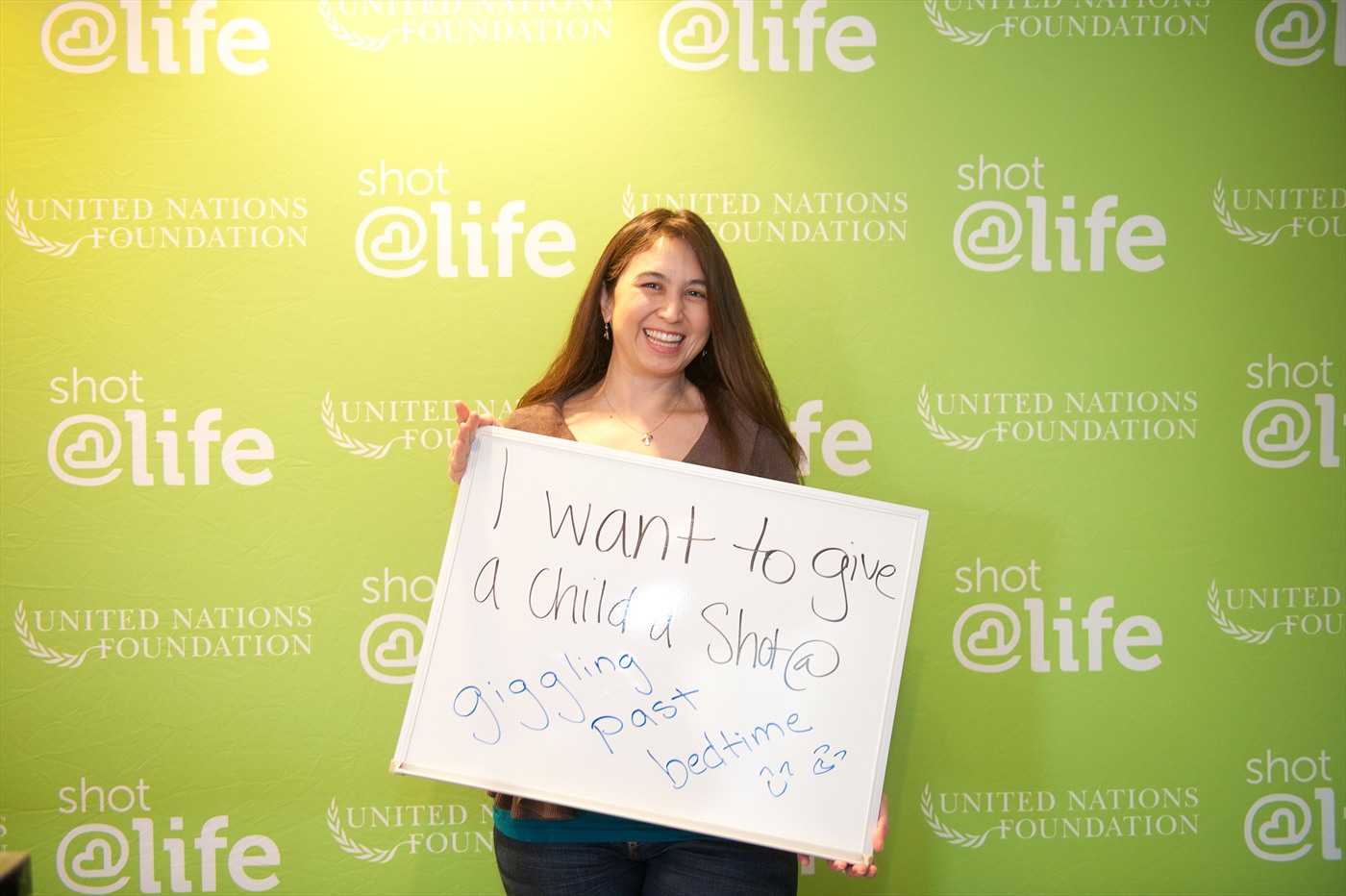
I want to shout it to the world that this has been one of the most fun and empowering experiences of my life. When I was accepted to be one of the very first champions before Shot@Life was even launched, I felt valued and honored, then scooped up and plunked into a room of 50 kindred spirits. Moms (it wasn't all moms, but mostly for the first champion summit) who are busy, loving, passionate about our causes, and always seeking to balance volunteering with work and caring for children. "All in" kinds individuals already used to throwing in all their skill and energy at something they believe in. Driven people who were similar in this characteristic, but coming from so many diverse backgrounds and skill sets as bloggers, pediatricians, advocates, etc. It has been so invigorating to learn from all of them and help each other grow. 

What specifically do I do as a Shot@Life champion? I advocate, promote and fundraise. Here's a glimpse at what me and my fellow champions have been up to:

I hope that gives a better view into what we're up to...and what you could be doing in 2013, too. Every action we take makes me feel more empowered and better connected to creating a better world for all children, including my own. Apply today for the Shot@Life Champion summit. Only 100 slots are available and the deadline is December 31. Good luck!


Tuesday, December 11, 2012

Shopping to Give Kids a Shot@Life

Still looking for special holiday gifts? Maybe an early Chanukah caught you unawares or you're searching for a meaningful way to put the "Christ" in Christmas. I have a suggestion...

It's simple: By donating to Shot@Life or shopping at their online store this holiday season, you are helping to give the gift of a healthy life to children around the world. 

Take a look at these great gift packages that your donations can buy. I've added some pictures from my Uganda trip with Shot@Life to help you see the real kids I met who are healthy today because of generous donors like you.

$20 provides immunizations for one child in need
Photo: InsiderImages

$60 protects 3 best friends from deadly diseases
Photo: Cindy Levin

$100 provides 5 classmates vaccines they need to survive & thrive
Photo: Cindy Levin

$1000 provides vaccines for an entire community
Photo: Insider Images

Even better, if you donate now, you'll receive a 25% off coupon code to purchase gifts on the Shot@Life online store. Woo! My favorite items are the Camelback water bottle, the iPhone cover, and the ShootieGirl rhinestone T-shirts...hint, hint...but there are lots of other cool things, too!


Thursday, December 6, 2012

Front Line Healthcare Workers are Heroes


A UNICEF staffer in Uganda assisting with a Family Health Care day

Through my advocacy work with RESULTS, I have become more and more aware of the importance of front line health care workers in remote areas where people live in extreme poverty. We can throw all the money we want at global health problems like AIDS or malaria, but without competent and dedicated staff in the field it would all be for nothing. Working on the ground to stop tuberculosis, for instance, inherently means risk of exposure to an airborne disease. Many times, lack of medical resources means lack of basic resources (like water!). These are the most challenging of conditions for any medical caregiver to work in.


I'll go ahead and admit that even though I'm an adult, sometimes a cartoon graphic can still help me understand more than a few paragraphs of text. So, when I came across this post on the website of the Frontline Health Workers Coalition, I wanted to share it to others. It is unbelievable how brave the caregivers are who administer life-saving care out in the field. They are heroes.

Please read Sarah Dwyer's post below and if you want to help, make sure your U.S. representative is on House Resolution 734, which recognizes the importance of frontline health workers toward accelerating progress on global health. I lobbied my representative, Congresswoman Jan Schakowksy, to co-sign it. My colleagues and I even convinced Representative Bob Dold (who rarely took action on global health issues) to co-sign it and write an op-ed in our local media in praise of it!

Saving Lives Shouldn’t Mean You Risk Your Own

Posted on 
By Sarah Dwyer and Rachel Deussom, IntraHealth International
Health workers shouldn’t have to put themselves at risk in order to do their jobs. But in fact, many frontline health workers face a wide range of occupational safety and health hazards—biological, physical, chemical, and psychosocial, as well as gender-based violence and discrimination.
Let’s take a look at one health worker—the nurse below on the left.
She’s facing a heavy workload and has many patients seeking her attention. The nurse is aware that the facility needs to be cleaned regularly to reduce risk of infection, but the janitor is absent. The lack of running water makes it even more challenging.
Our health worker is a dedicated employee—rather than leave when her shift is over, she takes time after the clinic is closed to do the cleaning. But the absence of her colleagues means more work for her, and she may not be able to do it all while taking measures to protect herself. Some health facilities lack proper disposal equipment, which can be dangerous for both the health workers and their patients.
Now it’s very late, and our health worker has to get herself home after dark. The road may not be safe, especially for a woman traveling alone. And when she gets home, she’ll have to do a lot of housework, meal preparation, and child care.
Then tomorrow she’ll do it all over again.
How can we help this nurse and other health workers like her? A new CapacityPlus technical brief, Ensuring a Positive Practice Environment: Occupational Safety and Health for Health Worker Productivity, outlines ways to make health workers’ safety a higher-level policy issue and shows how to create working environments that prioritize occupational health.
Just a few of the many hazards include:
  • Lack of sterile equipment and proper waste management
  • Exposure to bacteria, parasites, and blood-borne viruses such as HIV and hepatitis as well as communicable diseases such as tuberculosis, avian flu, and swine flu
  • Physical strain and injury
  • Bleach, lead, flammables, solvents, noxious vapors, and radiation
  • Stress, fear caused by violence or verbal abuse, and depression
The good news is that improving safety in the workplace can help address other service delivery issues and result in additional gains, from increased motivation and productivity to a stronger-functioning team.
To learn more, read the technical brief, and please let us know what you think. What are the occupational safety and health hazards faced by you or health workers you know? What is being done to reduce these hazards?