Friday, June 5, 2020

No Excuses, No Shame. Start Being an Ally Today.

I haven't posted about the massive Black Lives Matter movement sweeping across my country before now. That was on purpose. See, while I don't exactly identify as white (I'm mixed race white/Asian), I  know I am white in the context of this movement. So, I've been doing what Black leaders have asked of us. I've been watching, reading, learning, and - when I can - acting in a support role to help black-led activities. What I haven't done is written about how to take action against racism in America. This changes today.

I admit I've had a tendency to think I should let others who regularly work in the anti-racism area do the talking. I don't feel as educated or eloquent on race issues as I am about nutrition or housing.
I was thinking, "It's not my area"..but it is.
Centuries of unaddressed structural and systemic racism are the same forces of oppression that drive poverty in America and other countries. Racism and poverty are inextricably linked. So, I should do the same thing I always do: help get people into action by removing mental barriers that keep people from acting. Please know that I'm writing to fellow white people in this post from here on in.

Set aside shame

Here, I'm talking directly to white people with eyes newly opened to the realities of how Black Americans have suffered at the hands of our own law enforcement. Maybe you think things like, "I just didn't know" or "I had no idea it was that bad." Then, maybe you get embarrassed to realize that Black communities have been telling us for years and we just didn't listen. That embarrassment and shame can keep us from having the confidence to enter the movement. So, I'm telling you now...

Get over it.

Wallowing in the past doesn't make anything better. This is a case of "Do the best you can and when you know better, do better." You're here now. Let's get to work. If you move forward with a humble heart of service and an attitude of wanting to learn, you will help to make change.

The opposite of racist isn't "not racist." It's "anti-racist." It's not enough to sit back and say, "Well, I didn't do anything racist to anyone." Being silent and maintaining the status quo is keeping systemic racism in place. We have to get over ourselves and actually take actions to oppose racist policies whether it be educating others, protesting, promoting fairer policies about community policing and housing, or electing people who will enact those policies.

Do your homework

We can jumpstart ourselves into the "knowing better" part by doing a bit of homework before unintentionally doing or saying things that will hurt others. Robin DiAngelo, author of "White Fragility: Why It's So Hard For White People To Talk About Racism," states that white progressives cause the most daily damage to people of color. Find out what she means by that before you go out and do damage yourself.

Anti-racism work is hard. It's charged with feelings. Chances are that when you engage in it for the first, second, or third time, you'll probably stick your foot in your mouth and hurt others' feelings without meaning to. It's likely your own feelings will get hurt, too. But you can lessen those missteps by doing some upfront homework yourself.

And do your homework WITHOUT asking your Black friends for help. Laura Cathcart Robins, a Black podcaster and free-lance writer says, "Don't call or text me and ask me what to read or how to support me. I don't mean to be rude, but I'm exhausted and depleted; I'm put-a-fork-in-me-done with all that - please figure it out among yourselves."

There have never been more resources available about anti-oppression and racism. Books on the subject are in such demand that they're back-ordered at most bookstores. But I've heard many places are making them available for FREE on kindle and audiobooks. "White Fragility," "Me and White Supremacy," and "How to Be an Anti-Racist" are a few good titles to start with.

There are also no shortage of online articles to read online. Here are a few I recommend:

Black Lives Matter has also put this very long list together. It's pretty comprehensive and I have not read most of them! https://blacklivesmatters.carrd.co/#educate

But don't take too long doing the reading! "Antiracism is about doing and not just knowing," says Leslie Mac, an activist and a community organizer. Do your reading and keep doing it. Learning is a lifetime activity.

Do something...right now!

If you've been frozen thinking, "I don't know how to help," let's get over that hurdle. It might seem like the only way to help is by attending a protest, but that isn't true. Black Lives Matter has put out a list of literally hundreds of ways to help: https://blacklivesmatters.carrd.co

Of course, if you want to attend a protest, you certainly should! (remember to wear a face-mask and stand away from people to not spread the COVID-19 virus) Yet in the interest of overcoming barriers for people who can't or won't protest for whatever reason (and COVID-19 is definitely a reason), here is an incomplete list of other things you can do. There are so many ways to plug into the movement, that there are no more excuses to sit on the sidelines doing nothing.

  • Donate to a bail fund to release peaceful, organized protestors from jail
  • Donate to a victim's family
  • Work to elect local and federal candidates who stand for anti-racist policies by donating, phone-banking, or dropping off literature at doors.
  • Host a zoom book discussion about racism to educate your white friends
  • Call and write to your U.S. Senators. We can ask our U.S. Senators to sign onto the Justice in Policing Act of 2020 introduced by Senators Harris and Booker. The bill would ban the use of choke holds, establish a federal registry of misconduct complaints, make it easier for victims of police violence to recover damages by restricting the "qualified immunity" defense, collect data on use of force, and give the Justice Department more authority to investigate abuses by police departments. 
  •  Call and write to your U.S. Representatives. We can ask them to sign onto H.R. 7120: Justice in Policing Act of 2020 and the  H.R. 5777: Police Accountability Act of 2020
  • Sign online petitions
  • Back up your friends with supportive comments when you see them having tough conversations with friends/family about racism on Facebook
  • Join an advocacy group like RESULTS that has a clear anti-oppression mission. Learn to advocate for policies that will disrupt systemic racism (they just so happen to have an online conference this month!)
  • Write a blog post
  • Collect supplies to help keep protesters safe from COVID-19 and tear gas (You must coordinate with protest organizers to get them where they are needed. Joining a Black Lives Matter support Facebook group for your city is a good way to find them)
One last word about taking action..don't be a performance activist. If you go to a protest, document the action, but don't be posting selfies. Be present and helpful. You should share actions when they make sense and you are inviting others to join you, but you don't have to post screen shots of your donations. Just do the work humbly and follow the directives of Black leaders with grace and humility. This is what is required of us right now. 

Good luck on your journey. I'm gonna need it with mine!


Wednesday, May 6, 2020

Guest Blog: Lobbying on Zoom with UNICEF by Yara Changyit-Levin

Today's guest blogger is a very close colleague of mine: Yara Changyit-Levin. She is a high-school activist who writes the blog Thrill Seeking for Nerds (who want to change the world) and advocates about global health, climate issues, gun violence, and U.S. poverty. I admire how she trains other activists over Zoom and other digital platforms during isolation. I'm also pretty biased about her accomplishments because she's my daughter!

Our local senate office reached out to Yara recently to set up a lobby meeting via Zoom. So many good relationship building things happened in that meeting that I wanted her to share it with you. Perhaps you can pick up a few tips from this high-school UNICEF group? Their experience shows us how human the senate staffers are as they grow and learn new ways of communicating with constituents during this age of COVID-19.

If you'd like to support Yara and her UNICEF team members, please call your senate office and say, "My name is ____ and my zip-code is _____. Please ask the senator to sign Senate Resolution 511 to support Gavi, the Vaccine Alliance, to make sure children around the world have access to immunizations for measles, polio, and - eventually - COVID-19. Thank you."

Take it away, Yara...

--------------------------------------------------------------------

“You know, you’re the first meeting we’ve had that isn’t about COVID.”

I heard this from Senator Josh Hawley's aide in a virtual lobby meeting last week with my school’s UNICEF Club.

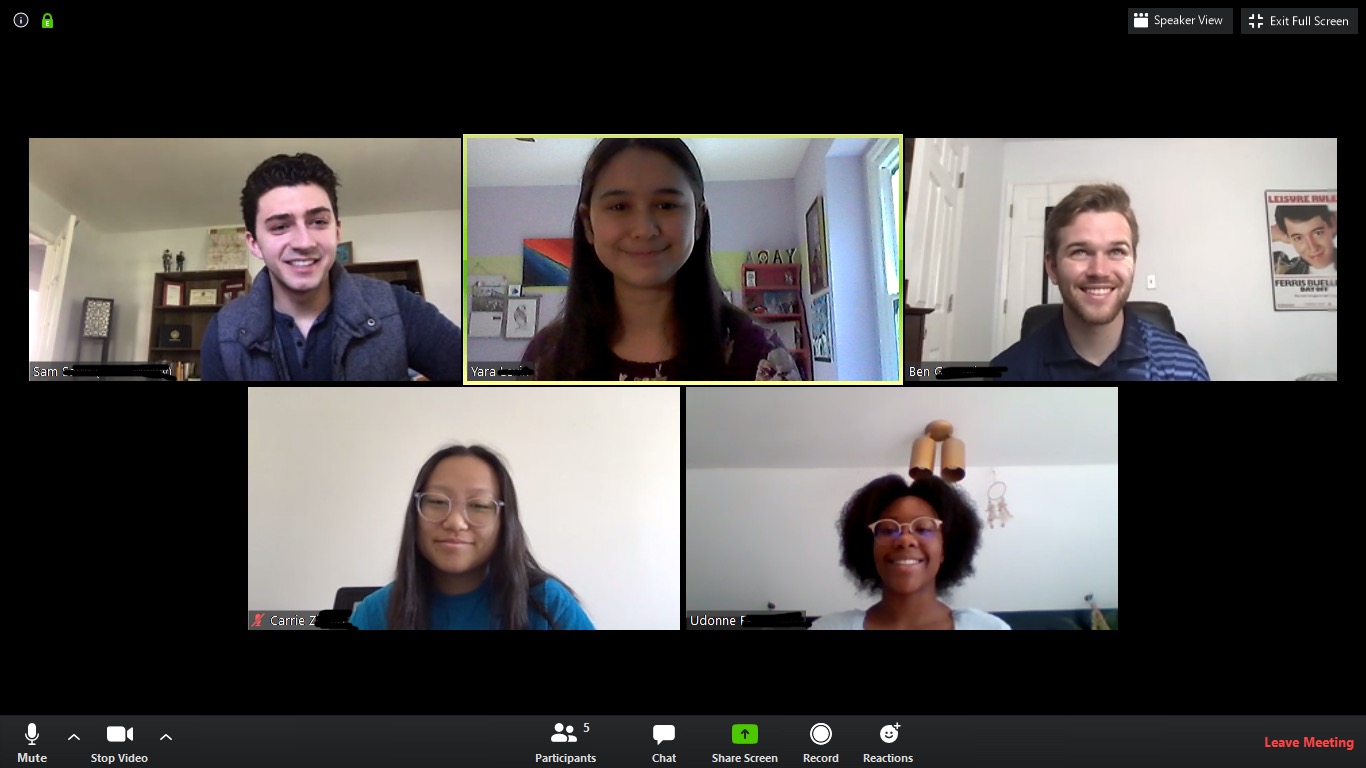
Yara (top center) facilitates the meeting with Senator Hawley's aides (top left and right)
and her fellow UNICEF Club members.

Many people are already familiar with UNICEF, the United Nations International Children’s Emergency Fund, which does exactly what the name implies. UNICEF has many different programs to put children first, including providing health care, education, emergency relief, and more in over 190 countries and territories.


So, what does a high school UNICEF Club do? We hold bake sales and other fundraisers for UNICEF, hold meetings, and we even make announcements at daily school assemblies when there’s a current event that affects children around the world, such as earthquakes in Puerto Rico or, most recently, the spread of COVID-19.


As Anti-Poverty Mom’s daughter, I was already familiar with UNICEF (having lobbied for funding and participated in trick-or-treat for UNICEF), so I was really excited to see this club at my school.


This school year, I became one of the club’s co-leaders and took on the role of Advocacy Lead, which has been very exciting! As a club, we’re doing more advocacy along the lines of RESULTS or Shot@Life, including our Valentine’s Day letter-writing to Congress. Before spring break, I hoped to hand-deliver our letters to a Senator’s local office and have our first lobby meeting as a club, so I submitted an official meeting request.


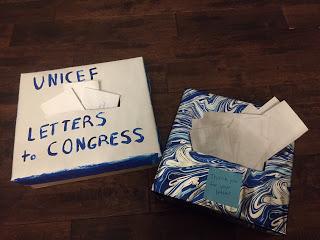
Letter boxes collected constituent letters at school and
at an at-home letter writing event before
COVID-19 isolation started.
Needless to say, COVID disrupted those plans. I wasn’t surprised when I didn’t hear back about that meeting. It just wasn’t going to happen.
But after four weeks, I got an email back! Not one, but two local aides were available to have a virtual meeting with us and get to know our UNICEF Club. I had a quick prep session with one of my co-leaders, who was lobbying for the first time.

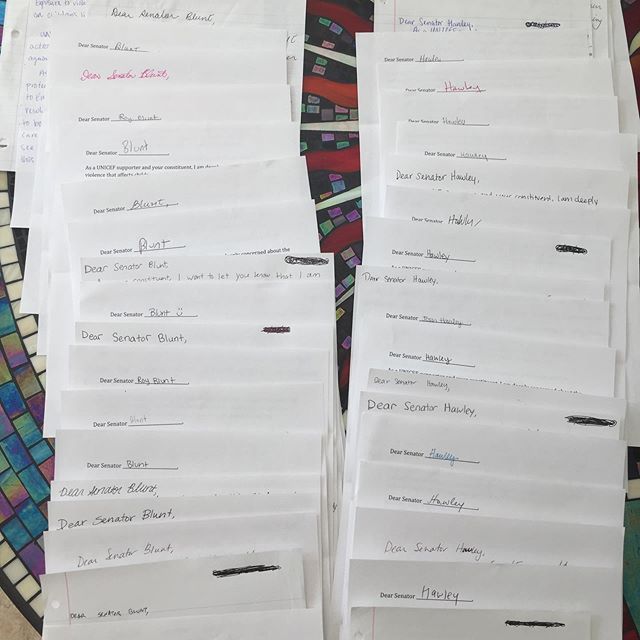
These letters from the collection boxes were packaged
together in a large envelope & mailed after the meeting. 


We talked about two bipartisan resolutions, S. Res. 112 (a framework to end all forms of violence against children) and S. Res. 511 (supporting funding for Gavi, the Vaccine Alliance). Mostly, however, we just talked about what our club was doing in the community and how we took an interest in advocacy, so we can build a relationship with this office. One of the senior co-leaders was able to join us to add her voice, as she’s been a leader for many years and seen the club evolve.

What was most interesting to me was what we learned about how Congressional aides do their jobs these days. These two had never used Zoom before, which surprised me, so they got to learn tips and tricks from a high school sophomore, junior, and senior! 

As I mentioned earlier with the quote that started this blog, they are really busy with COVID-19 stuff, trying to help their constituents navigate government agencies. One aide spends nearly all his time answering questions about the stimulus checks, when he himself still hadn’t received his own check! 

The aides for this office are working from home, so they can’t check the mail every day even when there’s a flood of constituents reaching out with various questions and demands. This meeting was a positive one for UNICEF Club and for our relationship to the Senator’s office— we all learned new lessons about communication between Congress and constituents. 

I’m looking forward to another year of UNICEF Club when we return to school, with more advocacy actions to follow. If you feel ready to take action with us, I recommend visiting https://www.unicefusa.org/help/advocate to find some handy, customizable emails that will actually reach Congress in a timely manner!

Tuesday, April 21, 2020

Safe Voting is a Fundamental Right of Americans

Many who know me often hear me say that advocacy is the most impactful way we can improve our government in the years between elections. It’s the way we can change policies beyond simply voting. But...what if we can’t even safely vote? 

Everyone should be nervous watching how the April 7th Democratic primary unfolded in Wisconsin. National and state officials understood COVID-19 to be transmittable at that point and the state had a stay-at-home order that started on March 25. In-person voting took place despite the governor’s attempt to postpone and shift the election to a vote by mail system. Citizens had to choose between exposing themselves to a deadly virus or exercising their right to vote. Today, NBC and NPR reported seven known cases of coronavirus were traced to voting.

What does this mean for all of us facing an election in November with no vaccine available? There doesn’t seem to be enough time to develop and provide a vaccine to the public, but there IS time to figure out a system for us to vote by mail. Sure, it feels both social and empowering to vote in person. Yet I’ve had to vote by mail before, and it was no less an act of powerful citizenship to do it that way. Heck, even Donald Trump (who opposes voting by mail) votes by mail.

Wendy Smith, a fellow mom-advocate and author of “Give a Little: How Your Small Donations Can Transform Our World,” has been mobilizing grassroots activists to advocate for such a system. She says, “Voting is the fundamental way we participate in our democracy. In a time of crisis like this, the right to exercise our participation must be made safe and trustworthy.”

I agree with her wholeheartedly. Voting is the most basic way we can make change to protect Americans in poverty and strengthen foreign policy protecting the health of everyone on the globe. It’s the most efficient way we can dismantle systematic racism that keeps citizens locked in a cycle of oppression. All the daily advocacy I do can be considered as EXTRA on top of our right to remove irresponsible leaders. Our right to vote should be guaranteed when we have the technology to do so.

Wendy continues, “Especially when facing a national crisis like the pandemic, we must be able to choose our leaders through voting. It is imperative that we protect this right by making it safe and secure.”

You know how candidates say each and every year that "voting is important now more than ever"? Well, guess what? It's during times of crisis that all the cracks in our systems are laid bare for everyone to see and we can see the weaknesses of our leaders. It's in times like these when people in poverty and racial minorities suffer the most. People are dying and suffering in hunger. We need to be able to elect the best possible leaders to guide us through the worst possible times. So, yes. Voting is important...now more than ever.

How can we take action?

1) Missourians can call the office of Governor Mike Parson at (573) 751-3222 and sign a petition to call on the state to make it safer for all to vote by allowing for absentee voting during the coronavirus pandemic. The Kansas City Star reported that the Governor does not consider “fear of spreading or contracting COVID-19 or abiding by a stay-at-home order” to be legally permissible reasons for Missourians to cast an absentee ballot.

2) Any American can use this link to urge senators to adopt Senator Warren’s plan in the next COVID-19 relief package assist states in expanding vote-by-mail for this November’s election.

If we start now, it is entirely possible that we can have a dependable system to vote by mail in place by the fall.